
Soft robotics
Soft grippers and actuators
Moulds with lost or removable cores for pneumatic channels in soft fingers and actuators.
Industries · Robotics and automation
Moulds for soft grippers and actuators, vacuum cups and bellows, gripper finger pads, protective covers and cable boots, from first prototypes to production quantities. For robot manufacturers, systems integrators, food and pharmaceutical automation, and research teams turning a soft robot into a product.
What automation teams need

A soft gripper that worked in the lab has to survive millions of cycles on a production line, gripping food, glass or electronics without marking them.
We tool soft actuators with internal channels, multi-material fingers and vacuum cups with controlled wall thickness and hardness, so every part behaves the same. Food-contact and other specialist grades are selected against your application, with data supplied.
We move with you from cast silicone prototypes through to compression or LSR production tooling, and keep the masters so replacement parts match.
Typical robotics work
Six families of tooling cover most enquiries in this industry.
Moulds with lost or removable cores for pneumatic channels in soft fingers and actuators.
Tooling for suction cups and bellows in grades and hardnesses matched to the product.
Moulded pads and textured contact surfaces for mechanical grippers.
Moulded protective covers, joint boots and cable grommets for harsh or washdown environments.
Food-grade and specialist silicone handling parts for packing and pharmaceutical lines.
Fast cast tooling for research prototypes, then production tooling when the design is proven.
Parts and tooling
A general guide. Geometry, material and volume decide the final tool.
Typical guide values, confirmed on your quotation. We confirm grade, tool life and lead time against your part and process.
| Part | Typical tooling | Typical run | Why it matters |
|---|---|---|---|
| Soft actuator | Multi-part mould with cores | Tens to hundreds | Channels and walls held to design |
| Vacuum cup | Compression or LSR tooling | Thousands | Consistent seal and lip |
| Finger pad | Multi-cavity cast tooling | Hundreds to thousands | Repeatable grip and hardness |
| Covers and boots | Cast or compression tooling | Hundreds | Fit over the arm, survive washdown |
| Prototype gripper | Printed-master cast tooling | Ones to tens | Fast design iterations |
Send the drawing, the material and the quantities with your enquiry so we can confirm the route before quoting.
Examples
Eight typical jobs for silicone, polyurethane and rubber tooling in this industry. Each one can be a single development tool or a full production set.
Silicone fingers that handle food, fruit and fragile parts.
Platinum siliconeCustom vacuum cups for odd shapes and delicate surfaces.
SiliconeCovers that protect joints and slides from dust and washdown.
SiliconeShaped pads that locate and protect parts in grippers.
PU, siliconeSoft bumpers for mobile robots and cobots.
PU elastomerGrommets, boots and strain reliefs for robot dress packs.
Silicone, rubberSoft skins over sensors for collaborative robots.
SiliconeSoft-faced nests that hold parts for automated assembly.
PolyurethaneTooling ideas, clearly explained
Larger customers ask the same questions: how is it checked, what is it made from, and can you make another one exactly the same? This is how we answer them.


Photos: Brandable Box, Jessica Streser, Wilhelm Gunkel, laura adai on Unsplash.
How we work
Please contact us before sending sensitive drawings or samples so that any confidentiality arrangements can be agreed.
You have a named contact for your programme, from feasibility to repeat supply, and is the person your engineering, quality and procurement teams speak to.
Material documentation, inspection requirements, manufacturing responsibilities and any necessary approvals should be specified and confirmed for your project before work is authorised.
Any tooling-specific terms, expected service conditions and remedies must be confirmed in your written quotation and order agreement.
Programme stages
We review the part, the material, the quantities and the deadline, and propose the tooling.
Please contact us before sending sensitive drawings or samples so that any confidentiality arrangements can be agreed.
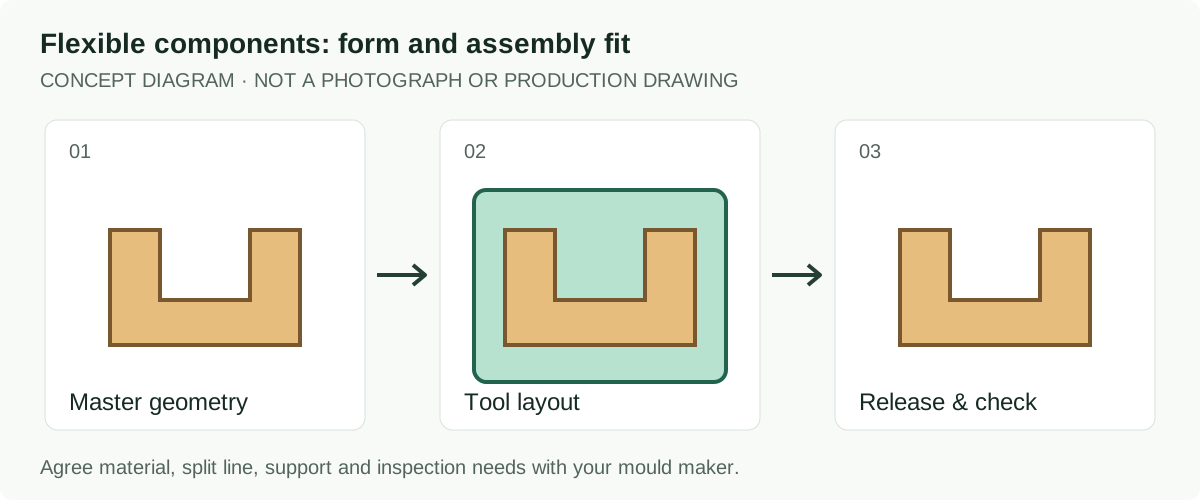
Master made from your CAD, scan or original, and the first tool trialled.
Fit, finish and release tuned from the trial before tools are duplicated.
Matched sets, planned replacements and archived masters.
Common questions
Yes. We use multi-part moulds with removable or lost cores, or bonded two-shot builds, depending on the channel geometry.
Yes, with multi-material moulding and grade selection. We test samples against your specified Shore hardness before production.
We use food-contact grades with supplier declarations where required and supply that documentation. Final compliance of the assembled system sits with the system owner.
Pricing depends on your design, materials, quantities and tooling scope. Ask us for a quotation against your project brief.
Related industries

Moulds for prosthetic covers and liners, orthotic pads, facial and body prostheses, and lifelike clinical training and simulation models.
Read more
Production moulds for lipstick, balm, solid perfume, shampoo bars and solid skincare, plus applicators and packaging inserts for prestige and contract cosmetics manufacturers.
Read more
Line-sized moulds, depositing trays and branded shapes for chocolate, confectionery, bakery, frozen dessert and ready-meal manufacturers, made through our sister division TCI Culinary.
Read moreStart a programme
We will propose the tooling, the grade and a fixed programme price.
Your project, our expertise
Contact TCI Mouldings with your drawings, samples and production requirements so the technical brief and next steps can be discussed.


 Thomas LaneManaging Director
 George PrestonDesign & Project Manager
 Kelly BallingerHead of Partnerships
 Jim AndertonProduction Manager
 TheodoreEmployee Welfare