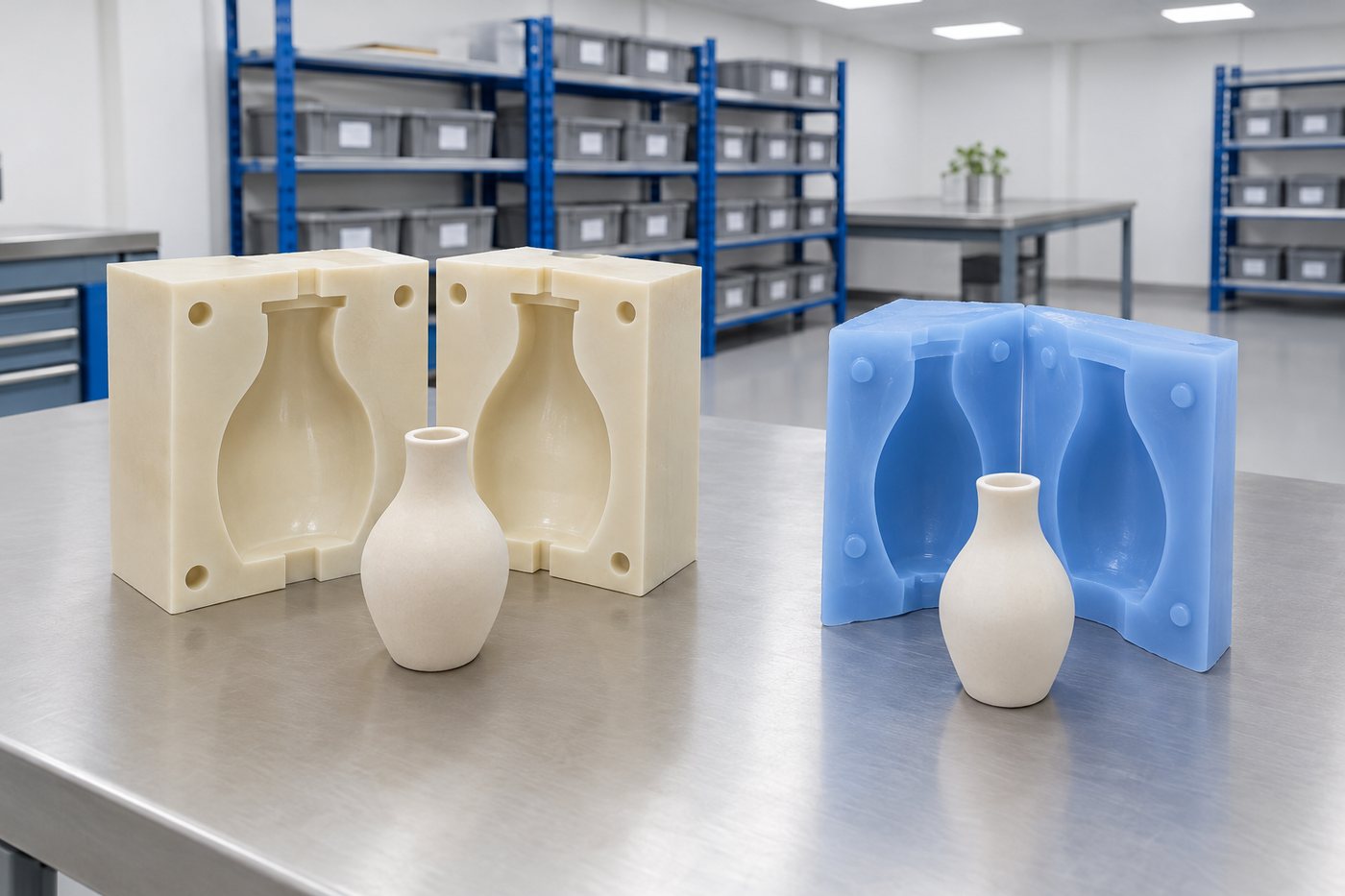
Anything with an undercut
A rigid tool cannot flex. If your part locks in place, the practical choices are to split the tool around that feature or change the part. Silicone would have shrugged it off.
Rigid tooling without cutting steel
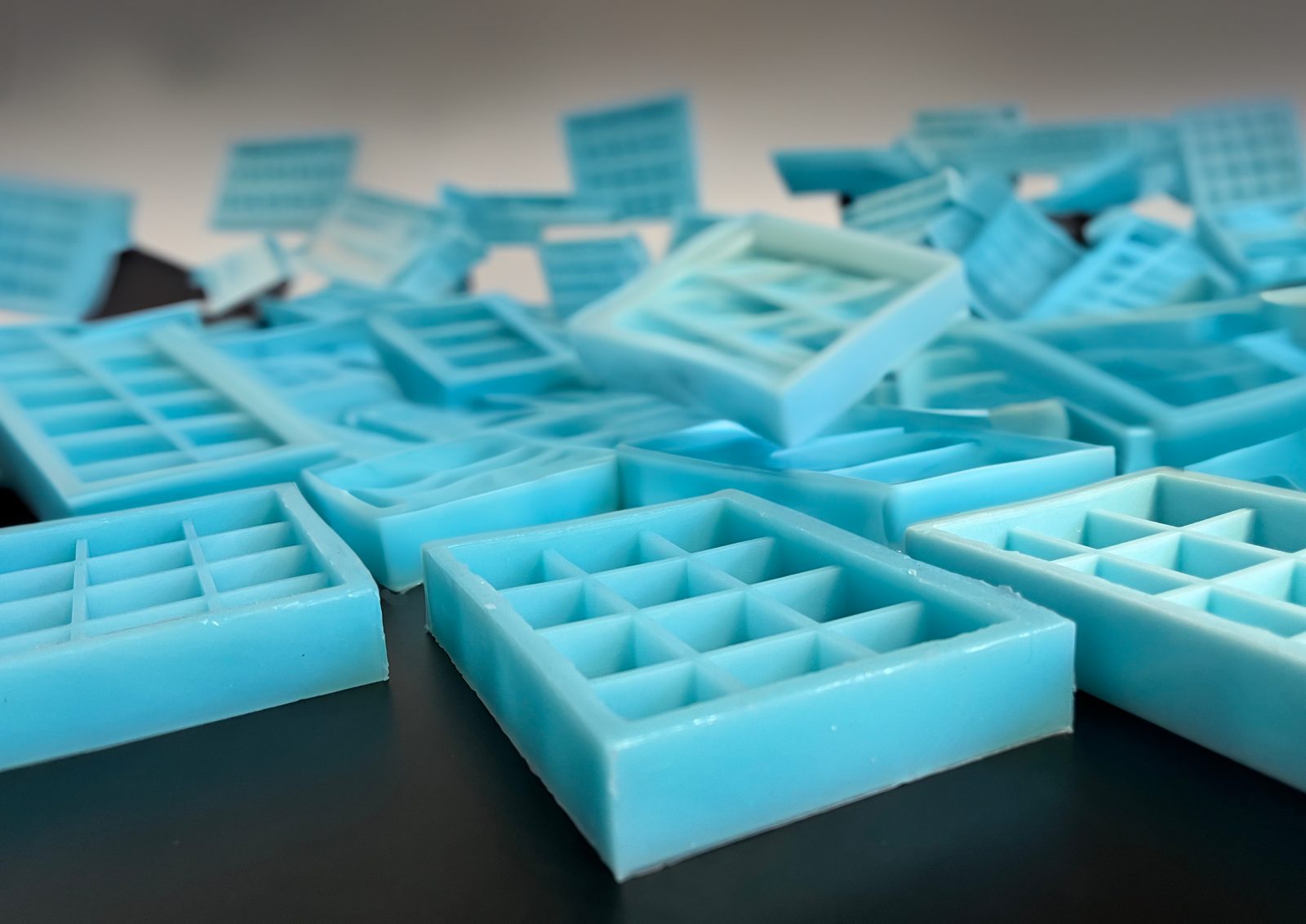
Polyurethane resin tooling sits between a silicone mould and a machined tool. It is rigid, costs less than metal and can handle tougher use than silicone. But it is more brittle, so it is less forgiving. It also cannot release an undercut at all.
Against silicone
Two soft-tooling materials with very different strengths. Choose the right one for your part, not simply the price.
| Polyurethane tooling | Silicone tooling | |
|---|---|---|
| Stiffness | Rigid. Holds a flat face and a straight edge | Flexible. Will bow under a heavy cast |
| Undercuts | None, unless the tool splits around them | Releases them by flexing |
| Release behaviour | Needs a release agent, every time | Usually releases on its own |
| Abrasion | Takes abrasive casting materials well | Wears and tears at thin corners |
| Failure mode | Chips and cracks, often without warning | Goes soft, tacky or tears gradually |
| Repairs | Can often be filled and re-faced | Rarely worth repairing |
The abrasion column is usually where urethane wins, while the undercut column is usually where it loses.
Where it wins
Working with concrete, cementitious mixes, terrazzo or heavily filled resins? These materials chew through silicone. A urethane face takes that punishment for far longer, which is why precast and cast stone work often ends up here rather than in rubber.
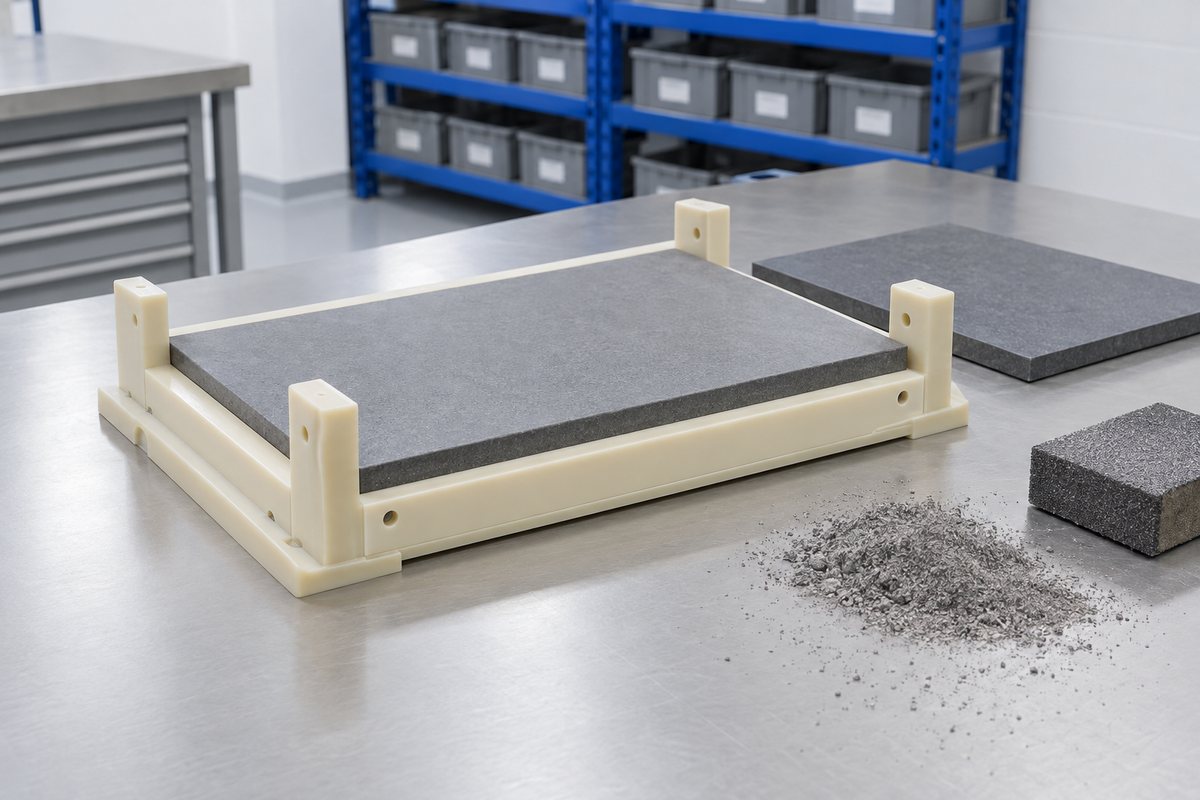
Tiles, panels, bases - anything that needs to sit flat or butt up against its neighbour needs support while the cast cures. A rigid tool holds the geometry in place. A flexible one can bow under the weight, creating a subtle dish that may go unnoticed until the parts are laid side by side.
Another common use is as a backing rather than the moulding face itself. A rigid urethane jacket supports a flexible brushed silicone skin. This lets the skin flex away from the detail, while the jacket keeps the whole mould in shape.
Where it loses
We prefer to tell you now rather than sell you a tool that cannot do the job.
A rigid tool cannot flex. If your part locks in place, the practical choices are to split the tool around that feature or change the part. Silicone would have shrugged it off.
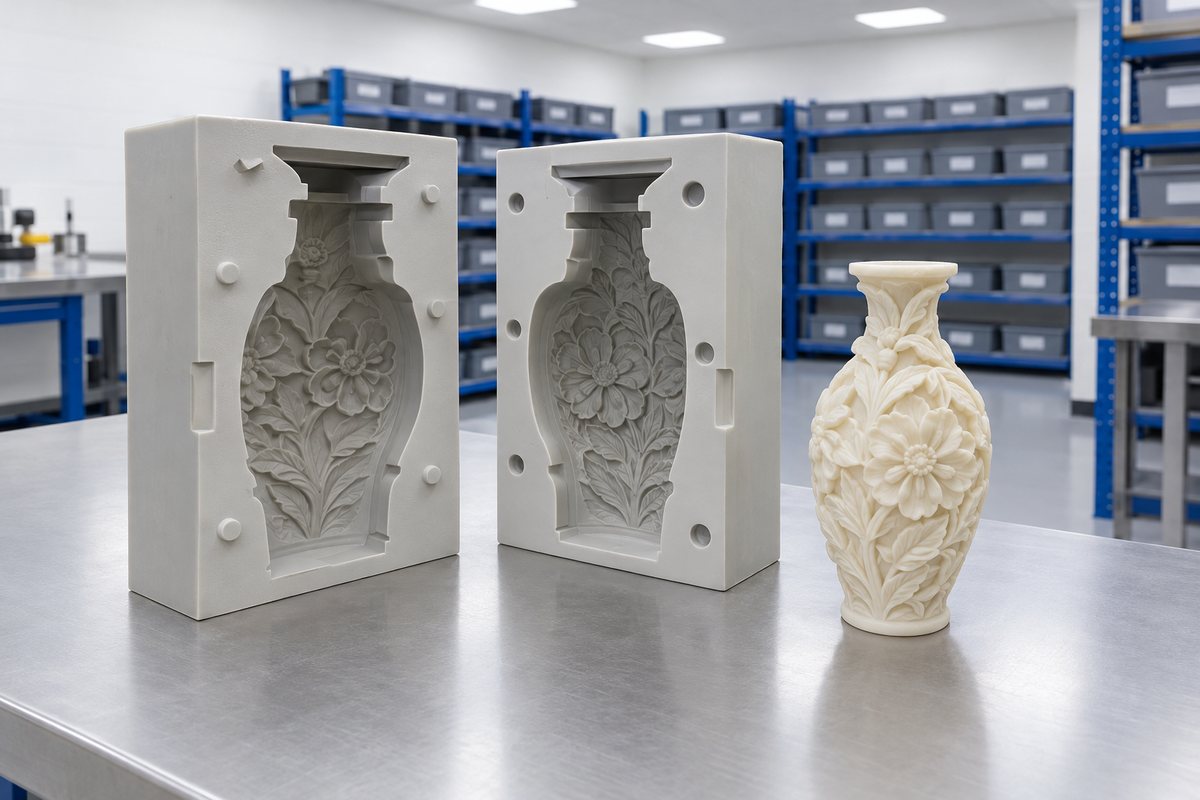
With a rigid tool, deep fine detail has to be pulled straight out, which can chip the tool or break the casting. For ornate work, a flexible mould is usually the better choice, often using vacuum cast.
Urethanes soften and distort at temperatures that silicone handles routinely, and repeated steam exposure is unkind to them. For hot work, choose high-temperature silicone.
For food-contact duty, we do not offer urethane tooling. This work is specified around grades and declarations, and is covered under food-contact moulds.
To quote it
Two answers matter most on this route: what you are casting into the tool, including the mix design if it is cementitious, and how the cast is struck off. Abrasion and alkalinity both attack the tool face. A trowel, a screed bar or a vibrating table each loads the tool differently.
After that, we can talk through how many pulls you need from the mould, whether your part has any re-entrant feature, and whether the face needs to be flat or can follow the master. Please also let us know if the tool will be moved between locations. Rigid tooling does not travel well unless it is designed for transport.
Urethane tooling starts with a properly prepared master pattern. A rigid tool copies a poor master just as faithfully as a flexible tool, so correcting it afterwards is more difficult.
Send us the mix, the part and a photograph showing how it gets struck. If urethane is not right for the job, we will tell you which silicone route is the right alternative.
At a glance
How a two-part mould fits together
Swipe to see the whole diagram
From idea to finished mould
Swipe to see the whole diagram
Ready to start?
Send us a drawing, photograph or sample. We'll come back to you with a mould strategy, a material recommendation and a price.
Real people, a real workshop
No call centre and no middlemen. When you contact TCI Mouldings, you speak to the team who design, build and check your mould.


 Thomas LaneManaging Director
 George PrestonDesign & Project Manager
 Kelly BallingerHead of Partnerships
 Jim AndertonProduction Manager
 TheodoreEmployee Welfare