For soap makers · Custom silicone soap moulds, made in Warwickshire
Silicone moulds for soap makers, cold process, melt and pour and everything between.
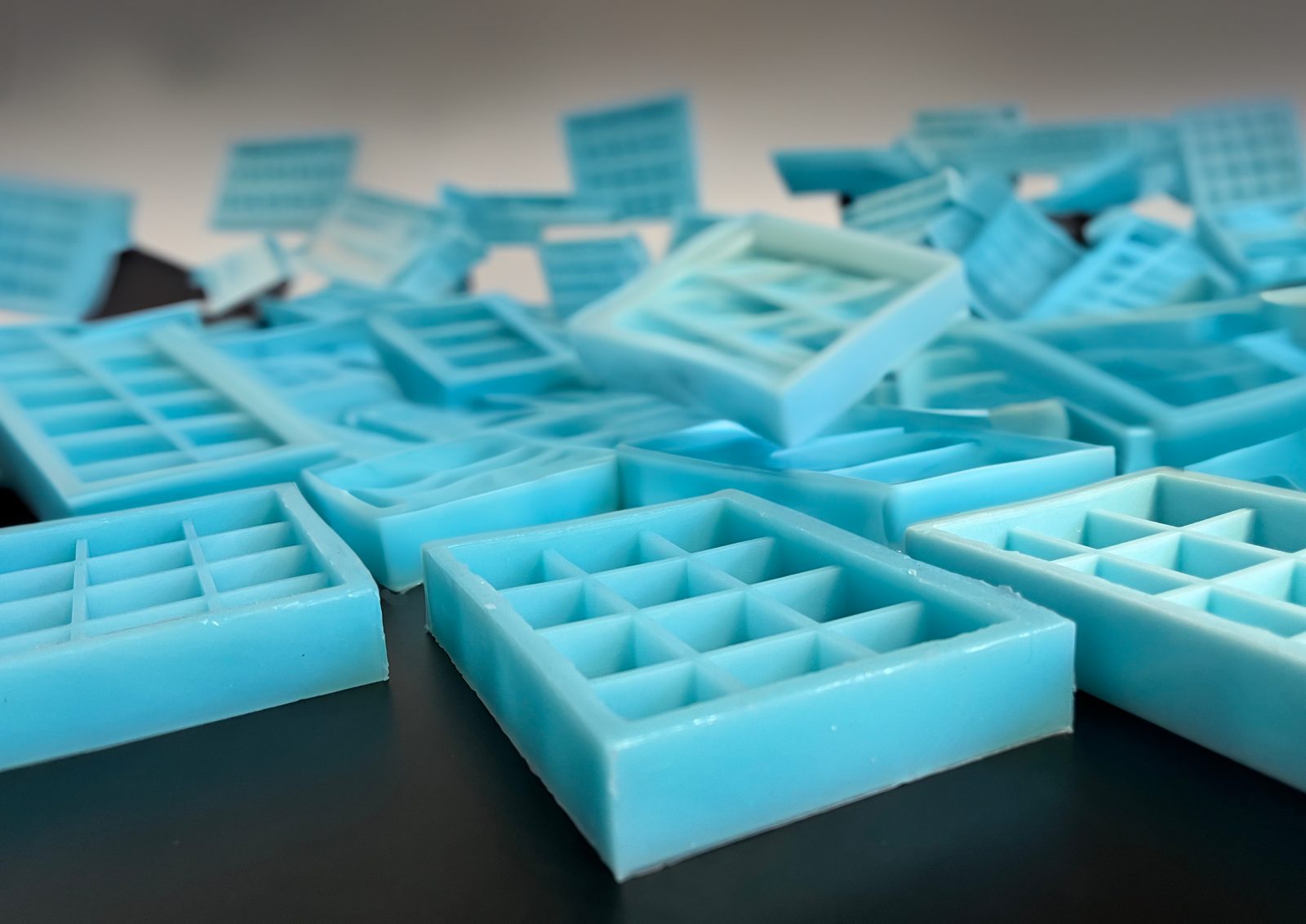
Loaf tooling built to sit through gel phase, bar cavities sized to a target weight, plus crisp embed moulds and decorative shapes. Each tool is specified for what your recipe actually does to it.
Cold process soap is alkaline and heats up on its own. Melt and pour is neither, but it sets quickly. Each process needs a different mould, so a shop offering one mould for both may not be paying close enough attention.
Fresh cold-process batter contains free sodium hydroxide and then goes through gel phase. During this stage, the exotherm, or heat released by the reaction, can climb well above room temperature.
Silicone handles this far better than most materials, which is exactly why it took over from wooden boxes lined with paper. Even so, the tool needs to be specified for the job: a grade with the heat behaviour to withstand gel phase without distorting, and walls thick enough not to bow while a full loaf is still soft.
Melt and pour presents a different challenge. The mould either releases early or does not release well at all, so edge definition and draft matter more than heat resistance. Glycerine bases will also happily pull detail from a soft grade if you demould in a hurry.
Embeds are a third case. You need a tool crisp enough to create a shape that survives being cast into a second soap. Tell us which of the three you make, and the specification more or less writes itself.
Your tooling questions change as your project develops, and our advice changes with them.
Illustrative example
Stage one
Kitchen table
Start with a stock loaf mould and get to know your recipe. Bespoke tooling cannot fix a trace that seizes or a fragrance that rices, so at this stage your money is better spent on lye, oils and practice. When you find a bar shape that people ask for by name, that is the right time to have a tool made. Bring a bar with you and we can quickly tell you whether you need a mould or a better cutter.
This is where consistency starts to pay off. A bar that varies in weight can make pricing and labelling awkward. Individual cavity moulds, sized for your target bar weight, remove the cutting stage and the offcuts that come with it.
It is also the right time to standardise on one or two footprints. That way, your curing racks, shrink wrap and postal boxes all work together. It may sound dull, but it saves a surprising amount.
For wholesale, repeatability and paperwork matter. We can match multi-cavity tooling to your curing space, hold spares for the tools you cannot run without, and keep a master on record. That means a replacement in two years is the same bar, rather than nearly the same bar.
If a stockist wants their own shape or an embossed logo, we can develop it under NDA and produce it without disturbing your own range.
What comes with every mould, no matter how small your order
Warranty-backed tooling
Your tooling is covered for two years or two thousand uses against a manufacturing defect, whichever comes first. We record the grade and specification against your order.
NDA as standard
Your bar shape stays yours. As standard, a master made for you is never used for another customer, and we do not publish anything without your say-so.
A named engineer
You have one technical contact who knows your recipe, your tooling and why the cavity is the depth it is, from enquiry through to reordering.
Small orders welcome
One mould is a perfectly sensible place to start, and many of the soap makers we supply began with a single loaf tool.
Cost per part, quoted properly
We spread tooling across the run you expect and show the labour per batch, so your trade price is clear rather than guesswork.
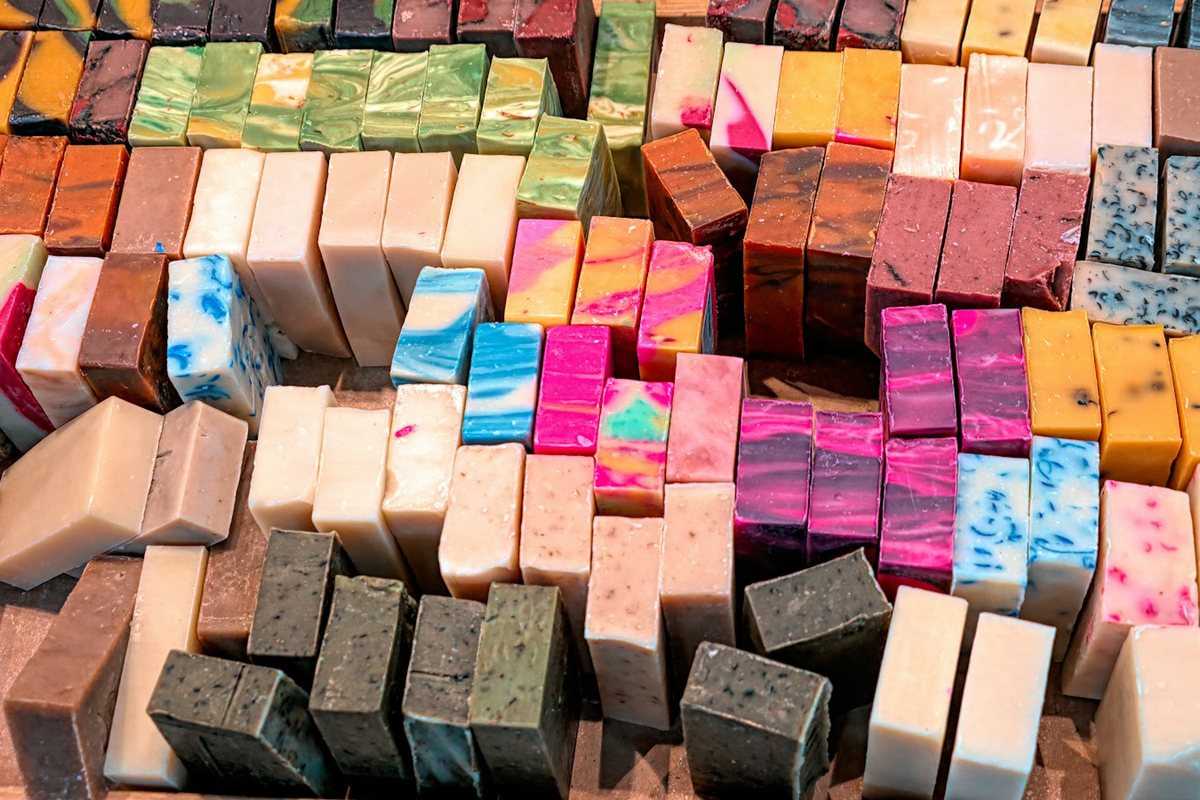
Colourful handmade soap bars stacked for sale
Learn from other people's bad batches
Six mistakes soap makers make
At some point, every one of these has arrived here as a photograph of a ruined loaf.
01
Specifying for melt and pour, then making it for cold process
The two processes need different heat behaviour and hardness. Tell your mould maker which process the tool is for. If it will be used for both, tell them that too.
02
Thin walls for a loaf mould
When a loaf is full, it stays heavy and soft for hours. If the walls are under-built, they bow, making the sides of every bar taper so your slices no longer match.
03
Demoulding before the soap is firm
If your part is sticking, give the cold process time to firm up properly before blaming the mould. Most sticking blamed on the mould is simply impatience, and a smeared face is not a tooling fault.
04
Fine detail on a bar made for regular use
Very fine relief looks wonderful on the first bar, but disappears after two showers. Bolder relief survives and photographs better anyway.
05
Avoid cleaning tools with anything harsh
Scouring pads, strong solvents and dishwasher cycles all shorten a mould's life. Warm water, a soft cloth and a little patience help keep your tool in good condition.
06
Sizing a cavity by eye
Bars are sold by weight. Work backwards from your target weight and recipe density, or you could spend a year explaining why the bars are short.
Typical work
What we make for soap makers.
Four tooling families cover most soap enquiries that reach our bench.
Illustrative example
One
Loaf moulds
Sliceable loaf tooling with walls built to take a full batch through gel phase, square internal corners for crisp bar edges, and a footprint designed to fit your curing racks.
Illustrative example
Two
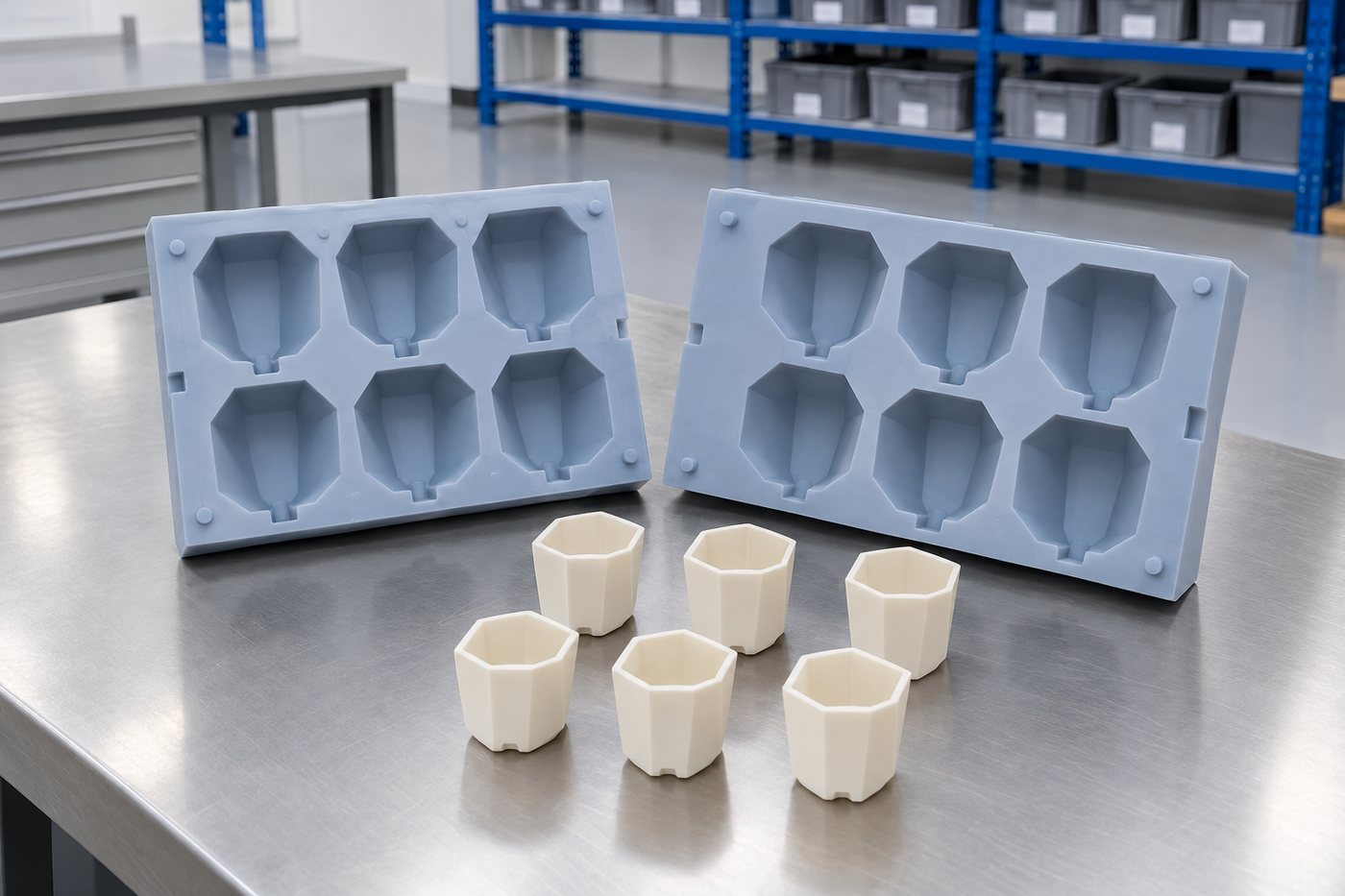
Individual bar cavities
We size cavity trays to your target bar weight, so cutting disappears from your process. They have draft on the walls and a base relief that can carry your name.
Illustrative example
Three
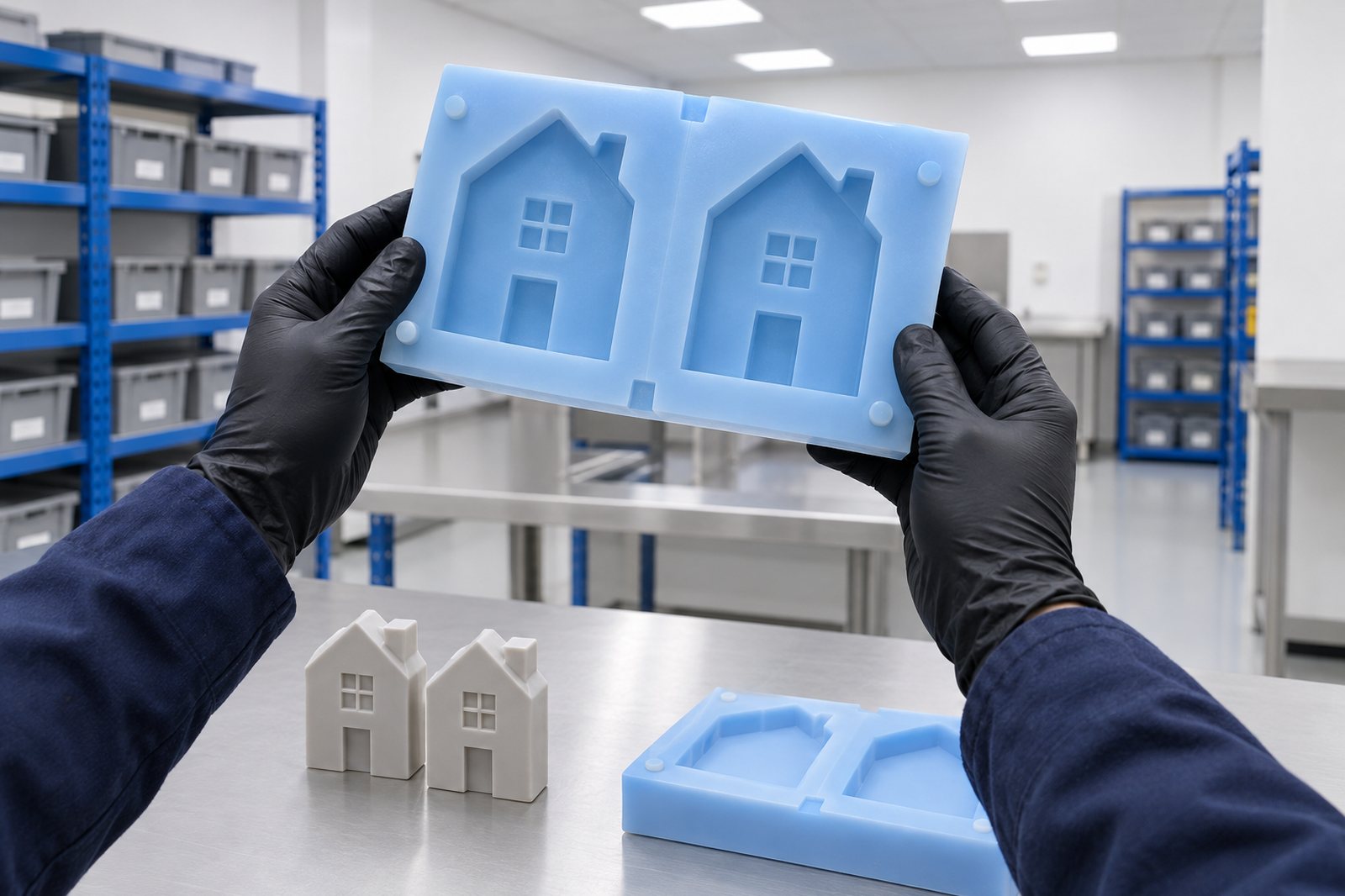
Embed moulds
This tooling is made for small, crisp embeds and toppers that need to hold their shape while a second pour goes around them. It is firm enough to strip cleanly at high volume.
Four
Layered and decorative shapes
Sculptural bars, layered forms and seasonal shapes are all possible. We solve undercuts with flex or by splitting the tool, rather than flattening your design to fit a stock tray.
If you are making cold process soap, silicone handles saponification well. That is why it displaced lined wooden boxes for this type of work. Tool life depends on more than the lye alone: alkalinity, the exotherm of gel phase and repeated handling all play a part.
Choose the right grade for heat behaviour and tear strength, and build the walls properly. Wash your loaf tool with warm water rather than solvents, and it should give you a great many batches. We will give you an honest expectation for your recipe, and we prefer to quote for a spare than oversell the life of one.
Does gel phase damage the tool?
Not if the tool has been specified for it. Gel phase raises the batter's temperature well above room temperature, and a poorly chosen grade can soften or take a permanent set at that point. This can show up as bellied sides.
The solution is a material with the right heat behaviour and an even wall thickness, so heat is not held in one place. If you deliberately force gel with insulation or a warm oven, mention this when you enquire, as it changes the specification.
Why do my bars develop soda ash or bloom?
This is usually a recipe and environment issue rather than a tooling issue. Soda ash forms on exposed soap surfaces in cool, humid conditions, while bloom on melt and pour is usually caused by condensation and temperature swings. A mould cannot cure either problem, but covering the top of a loaf and keeping the curing area stable helps a great deal.
We mention this because it is often reported as a mould complaint. It is worth ruling out these causes before you spend money on new tooling that may behave in exactly the same way.
How long before I can demould?
The honest answer is that it may take longer than you'd like. It depends on your recipe, water discount and temperatures, rather than the mould. Cold process generally needs to firm properly before it will release from a tool with clean faces. Individual cavities usually release sooner than a full loaf because the mass is smaller. Melt and pour is quicker by comparison, but patience around the edges helps. If you are consistently struggling with release at a sensible cure time, send us a bar and we will look at the geometry.
Do you offer a cold-process-safe silicone?
For cold process work, we specify grades that fit the job. In practice, that means choosing a platinum-cure silicone for its heat behaviour and tear strength, with a wall thickness suited to your batch size.
We won't give it a marketing name and imply a certification that does not exist. If a retailer needs documentation, tell us what they are asking for and we'll explain plainly what can be evidenced.
Food-contact work runs through TCI Culinary, our sister division.