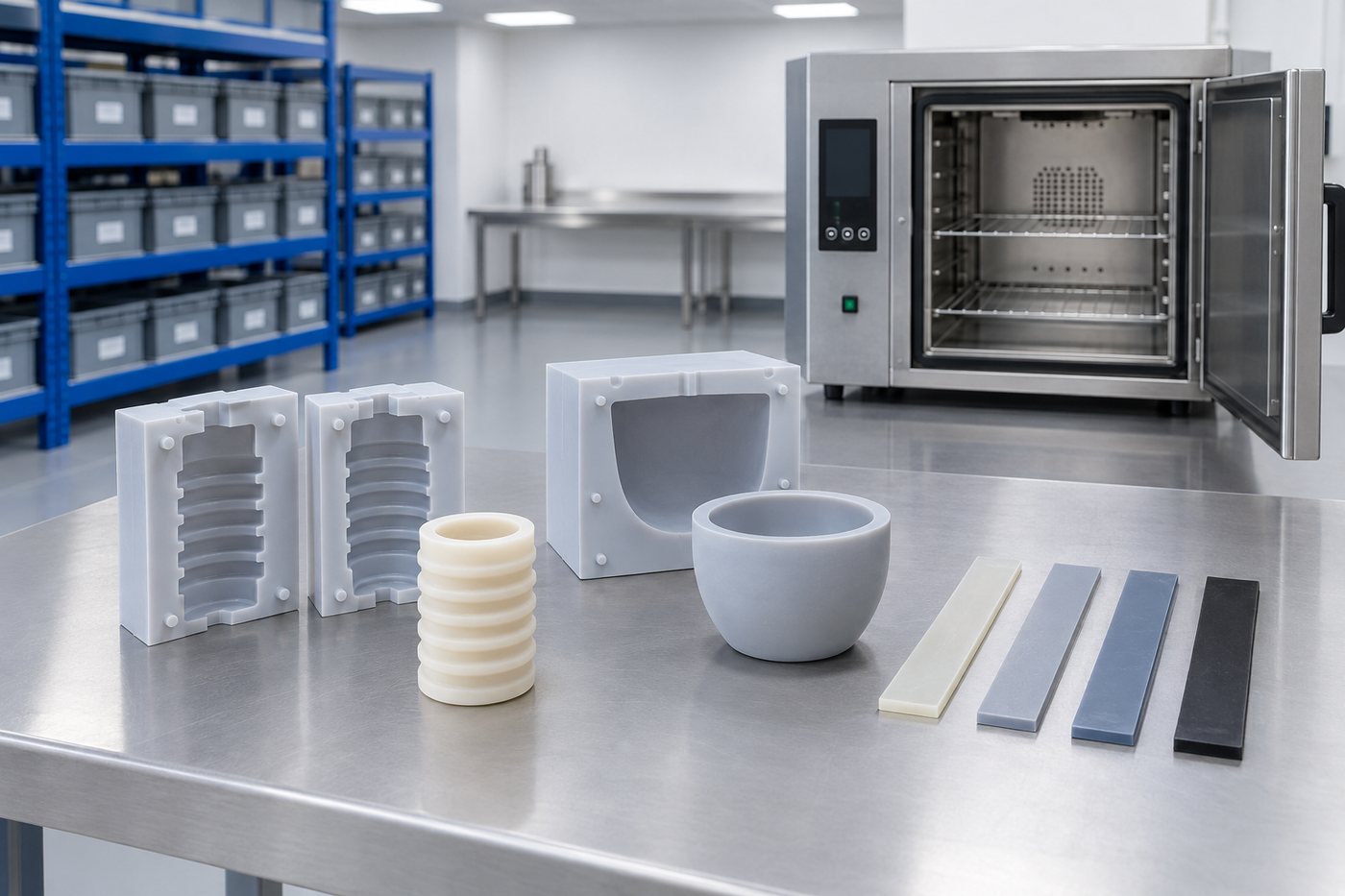
How hot it gets and how long it holds that heat
Please share the actual process temperature and dwell time, rather than the equipment's maximum setting. If the temperature varies across the load, tell us the hottest place the mould sits.
Specified around the cycle, not the peak
If you need moulds or moulded parts to work hot, you may be dealing with ovens, curing lines, autoclaves or resin exotherms. Silicone handles heat better than most rubbers, so it is easy to assume that any silicone will do. It will not. The way it fails depends on how the heat arrives.
How it goes wrong
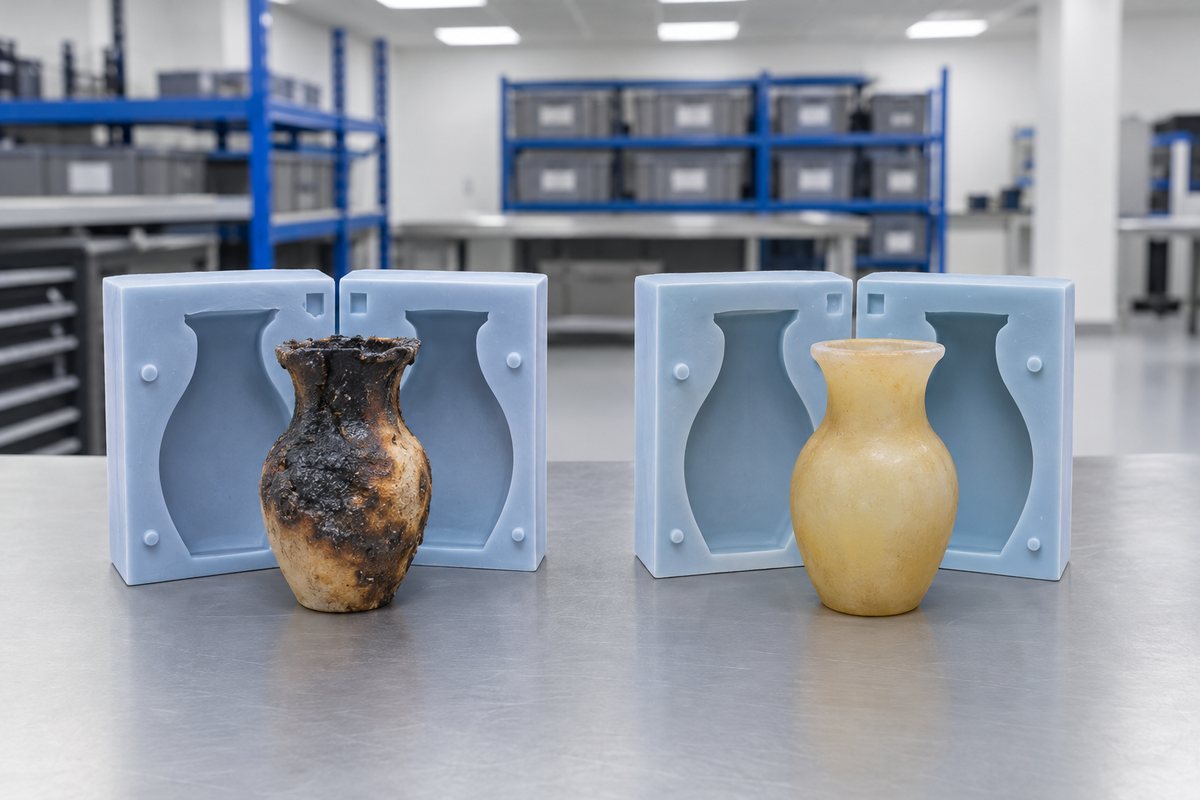
Heat can kill silicone moulds in two completely different ways. Understanding the difference helps you choose the right mould for hot jobs, rather than ending up with the wrong one.
The first is a single overheat: the mould goes somewhere it was never specified for, just once, and comes back hard, shrunken or crazed. This is an obvious failure with an obvious cause. Usually, it means the specification was written around the average rather than the worst case.
The second is slower to reveal itself. Every cycle takes a little of the material's life. The mould keeps working for a long time, gradually stiffening and losing elasticity. Then, one shift, it tears on a corner it has released cleanly for months. Nothing changed that day. It had simply had enough cycles.
The second one is what can really cost you money, which is why we ask how often you will use the mould as well as how hot it will get. A mould for an occasional bake and one for a line running all shift need different specifications, even at the same temperature.
Post-curing
Silicone that has cured is not necessarily finished. After demoulding, a post-cure, which is a controlled bake, drives off residual volatiles and settles the material's properties. This helps it behave the same at temperature as it did on the bench.
It matters for three reasons. First, it reduces the amount of material that can outgas, or release gases, into what you are casting or cooking. It also stabilises hardness, so the mould does not quietly stiffen during its first few hot cycles. Finally, it removes the smell that unbaked silicone can carry into food work.
Post-curing isn't free, and it isn't always necessary. A mould for cold plaster casting gains nothing from it. But a mould used in an oven, or one used for food contact, will usually repay the extra step several times over.
We'll let you know whether your job needs it. If we recommend it, that's because of the duty you described, not simply because it sounds thorough.
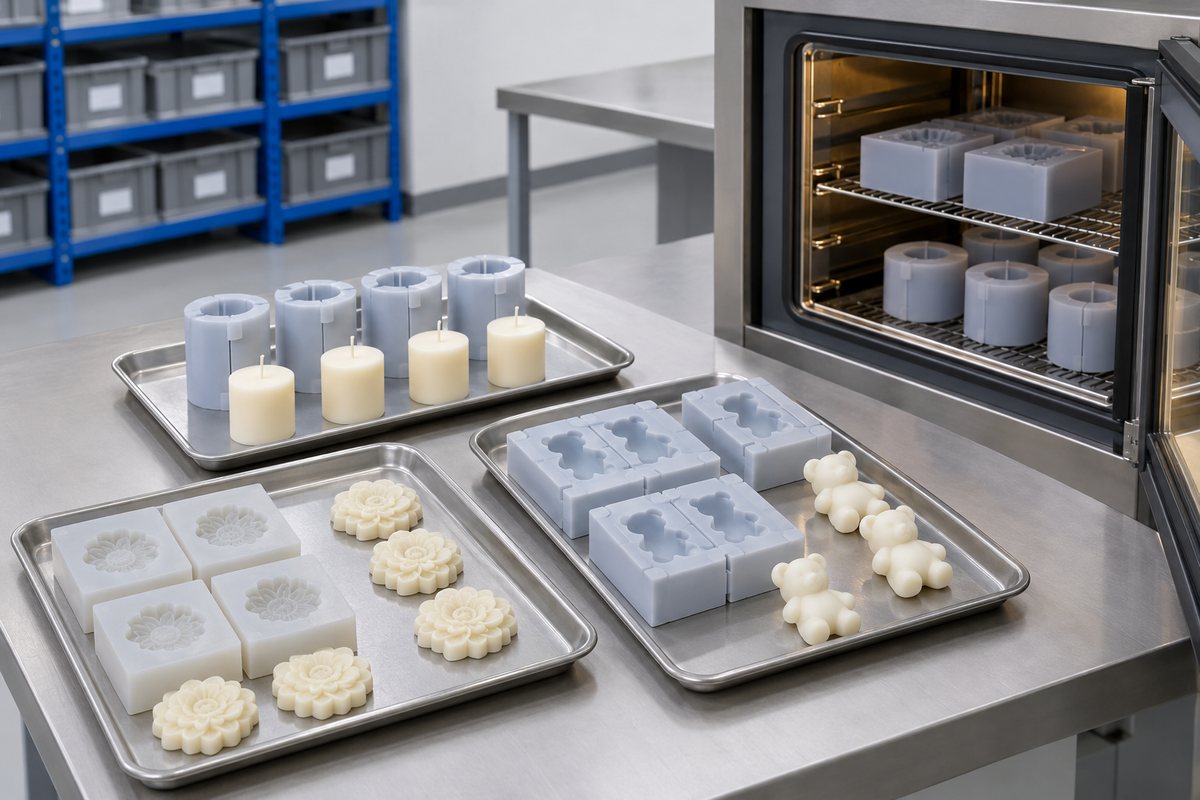
Why we will not
Many suppliers quote a single maximum temperature for silicone. We do not list one on this page because, on its own, it is close to meaningless and can invite exactly the failure described above.
A material's rated maximum assumes brief exposure to clean, dry heat, with no load on the part. Change any of those conditions and the useful working figure changes too. Continuous heat instead of intermittent heat. Steam instead of dry air. Compression while the part is hot. A wash cycle between bakes. Each condition moves the working figure further from the catalogue number.
Instead, we start with your cycle. You tell us the temperature, how long it holds, how often it happens, whether anything presses on the mould while it is hot, and what it is cleaned with. We then specify a grade for that duty and record it against your order. That way, when you place a repeat order, you get the same material rather than something similar.
One other limit is worth stating plainly: high-temperature grades tend to be less flexible and less tolerant of rough handling than general purpose grades. You are trading easier demoulding for longer thermal life. If your part also has awkward undercuts, that trade-off can become uncomfortable. In most cases, a design change or a different route is the better answer than choosing an unnecessarily demanding grade. See shore hardness selection for guidance on balancing these factors.
To quote it
Please share the actual process temperature and dwell time, rather than the equipment's maximum setting. If the temperature varies across the load, tell us the hottest place the mould sits.
Whether it is used occasionally, daily, or on every cycle throughout a shift, this is the number that determines whether we are specifying for survival or for working life.
Whether you are using an oven, steam, an autoclave or a heated platen, remember that steam and pressure are much harder on silicone than dry air at the same temperature.
How heavily the mould is loaded while hot, which cleaning chemicals are used between cycles, and how quickly it is cooled all matter. Thermal shock and chemical attack finish more moulds than temperature alone.
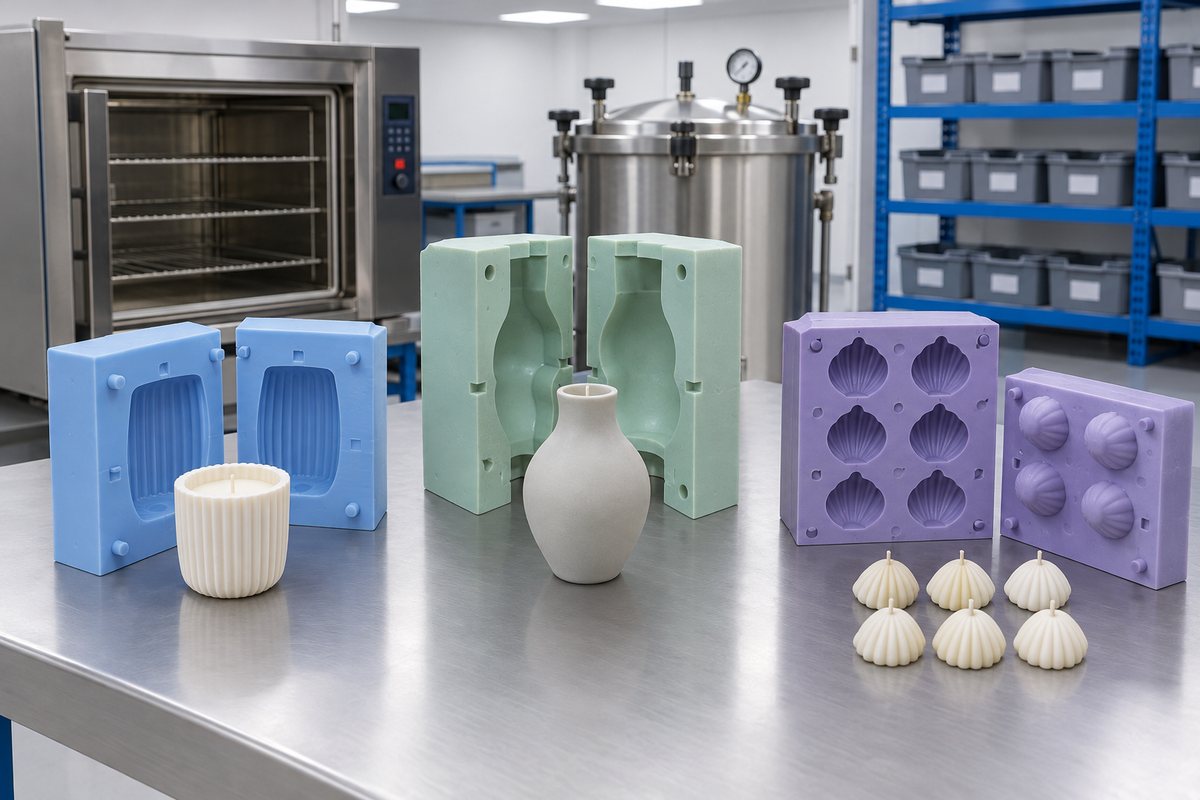
At a glance
From idea to finished mould
Swipe to see the whole diagram
Ready to start?
Send us a drawing, photograph or sample. We will come back to you with a mould strategy, material recommendation and price.
Real people, a real workshop
No call centre and no middlemen. When you contact TCI Mouldings, you speak to the team who design, build and check your mould.



 Thomas LaneManaging Director
 George PrestonDesign & Project Manager
 Kelly BallingerHead of Partnerships
 Jim AndertonProduction Manager
 TheodoreEmployee Welfare