Bidford-on-Avon, Warwickshire. Mon to Fri.01789 224228

Silicone mould guide

Platinum-cure vs tin-cure silicone: what does your chandler need?

There are two cure systems, and choosing the right one affects shrinkage, tool life, what can damage your mould and whether food-contact paperwork is possible at all. The difficulty is that most suppliers will not tell you which system you have bought.

2Cure systems
8Properties compared
6Questions answered
2019Established

Two chemistries

Same material, two entirely different personalities.

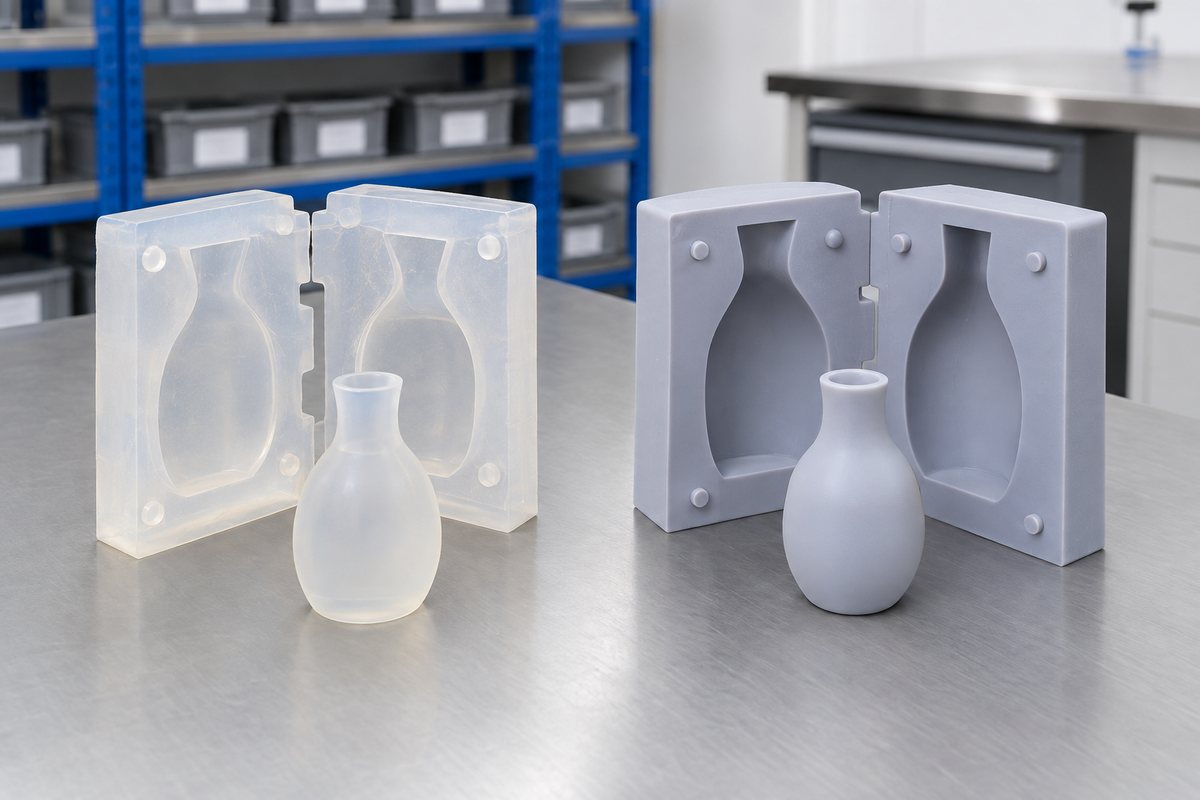
Illustrative example: Two silicone mould samples with different clarity and finish
Two silicone chemistries with very different behaviour

Silicone moulds cure by one of two routes: platinum cure, which the trade also calls addition cure, or tin cure, sometimes called condensation cure. The names describe the catalyst, and the catalyst affects almost everything a chandler needs to know: how much the mould shrinks, how long it lasts, what can ruin it and whether food-contact paperwork is possible at all.

Suppliers rarely explain the difference. Partly because it takes a paragraph, and partly because the cheaper of the two often sells better without it. So here it is in practical terms. If you remember one thing, remember this: platinum is the fussy one that lasts; tin is the forgiving one that ages.

The wider silicone knowledge hub

Side by side

Platinum versus tin for candle work.

This comparison applies to wax. For concrete, plaster and resin, the weighting changes.

How the two cure systems behave in a chandler's workshop.

PropertyPlatinum cure (addition)Tin cure (condensation)
Shrinkage on cureVery low. Dimensions hold.Higher, and it continues slowly with age.
Working life of the toolLong. Ages slowly and stays flexible.Shorter. Gradually hardens and can go chalky.
Detail reproductionExcellent, down to fine surface texture.Good, though it softens fine detail sooner.
Tolerance of a dirty masterPoor. Can be inhibited and left tacky.Very good. Cures against almost anything.
Heat behaviourBetter suited to warm and hot pours.Adequate for cooler pours, less happy hot.
Food-contact gradesAvailable, with declarations behind them.Not the route for declared food-contact work.
Cost of the raw materialHigher.Lower, which is why cheap moulds use it.
Best candle useProduction tooling, repeat runs, fine detail, hot waxes.One-off moulds, trials, and masters of unknown make-up.

Neither option is better in every situation. Choose the wrong one for your job, though, and you risk wasting a mould. This page is here to help you make the right choice.

Contamination

What ruins each one.

Platinum cure can be sensitive to what it touches during curing. If you are making a mould for the first time, sulphur-based modelling clay is the classic offender. It is why some first attempts end up with a tacky, sticky face that never sets. Latex, some polyester resins, certain tapes, a few printed materials and residues from older tin-cure moulds can cause the same problem. It is not a bad batch, and waiting will not rescue it. The cure has simply been stopped.

Tin cure is almost indifferent to what it sets against. It can set against clay, most resins and even a greasy shop-made pattern, which is why hobby kits and cheap import moulds use it. The trade-off is shrinkage, a shorter life and slow hardening. Over time, this can turn a supple mould into a rigid one that cracks at a corner.

For a chandler, this usually resolves cleanly. If you know what your master is made of and it is clean, platinum is the choice every time. If the master is a mystery object, such as an old candle of unknown composition or something made in modelling clay, you can either seal it properly first or accept a tin-cure tool as a stepping stone. We have written up a job where this went wrong, rather than pretending it never happens.

Materials and compliance
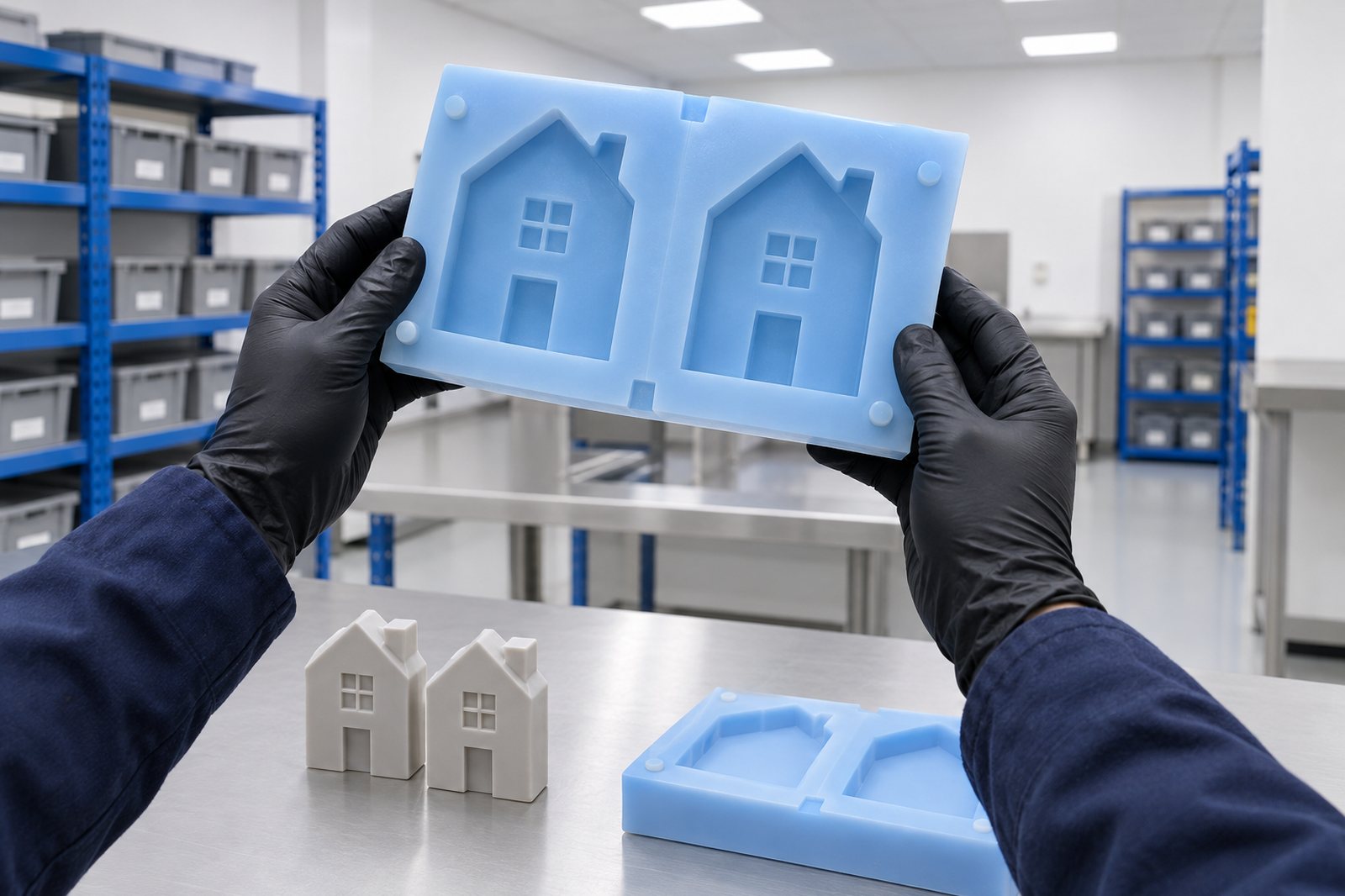
Illustrative example: Cured silicone with fine relief inspected against the light for surface defects and tacky patches

Food contact

When a mould is used for candles and food, the paperwork changes.

Chandlers encounter this more often than you might expect. It might be wax melts sold alongside confectionery, a candle presented in a bowl that also gets used for food, or a brand making both candles and chocolate moulds from the same shape. Most commonly, though, it is a mould bought for candles that somebody later decides to use for baking.

The word silicone alone does not make a food-safety claim. For food-contact work, you need a declared grade backed by documentation. That declaration applies to the specific material, not to silicone as a general term. These grades exist with platinum cure, but not with tin cure.

If any part of your product touches food, we route the work through TCI Culinary, our sister division. That is where the food-contact specification and paperwork are managed. The work stays in the same workshop, with the same engineering, but it is handled under the right specification rather than improvised. Not sure whether your product counts? Ask us. We can give you a quick answer, and it is much cheaper than finding out later. The general position is set out on food-contact moulds.

Hardness

Typical Shore A ranges for wax work.

Wax is light and gentle, so candle tooling sits towards the softer end of what silicone offers. Even within that range, you still have a real choice to make.

Softer end

For detail and undercuts

For deep flutes, moulded textures, waisted shapes and anything that needs to be peeled back rather than lifted off, softer silicone can be a good fit. It reaches into the detail, releases cleanly and is more forgiving if your operator is working quickly. It also stretches over time, so a long production run will gradually lose crispness. Plan to replace it sooner and price your moulds accordingly.

Hand-made moulds
Firmer end

For repeat runs and clean shapes

Plain cylinders, generous tapers, simple geometric pillars and wax melt trays are well suited to a firmer tool. It holds its dimensions over a long production run, resists sagging when a tray is full and stands up to production handling. Each pull takes more effort, and it will not release a difficult undercut, so the shape needs to allow for easy release.

Shore hardness selection

We won't put a hardness value against your application, and we'd be cautious about anyone who does. Shore A is one measurement taken with a sprung point. It tells you nothing about tear strength, elongation or recovery. That's why two grades with the same reading can have completely different working lives. Wall thickness affects behaviour just as much as hardness does. So we measure the cured material, record the reading against your order and use that record when you come back for another one.

Cheap moulds

Why the bargain mould fails early.

  1. Tin cure needs an explanation

    There is nothing wrong with tin cure in the right application. But if a supplier will not tell you which chemistry your mould uses, it is because the answer would not help the sale. Ask directly, and take the silence as your answer.

  2. A poor master passes on its flaws

    Every candle you pour inherits the surface of its original master. If a mould is taken from a rough print with visible layer lines or a worn production part, those flaws pass to every product forever.

    No amount of good silicone can fix a bad master. That is why we spend real time on master patterns.

  3. Your wall thickness should not depend on the pour

    Cheap moulds are often poured into a box without enough thought about the finished wall thickness. That can leave one area thin and another unnecessarily heavy.

    The thin spot is usually the first to tear, often at the same point every time.

  4. No draft and no designed split

    Draft is the slight taper that helps a candle come out of its mould. Without it, removal takes force, which can mark the candle and shorten mould life. A split line placed wherever it is easiest to make will show on the front of your product.

  5. Nobody asked what you were pouring

    That is the clearest warning sign. If nobody asked about your wax, pour temperature or throughput, the mould was not specified for your needs. It was simply made, leaving you to find out what it suits.

Explore the five routes we work in

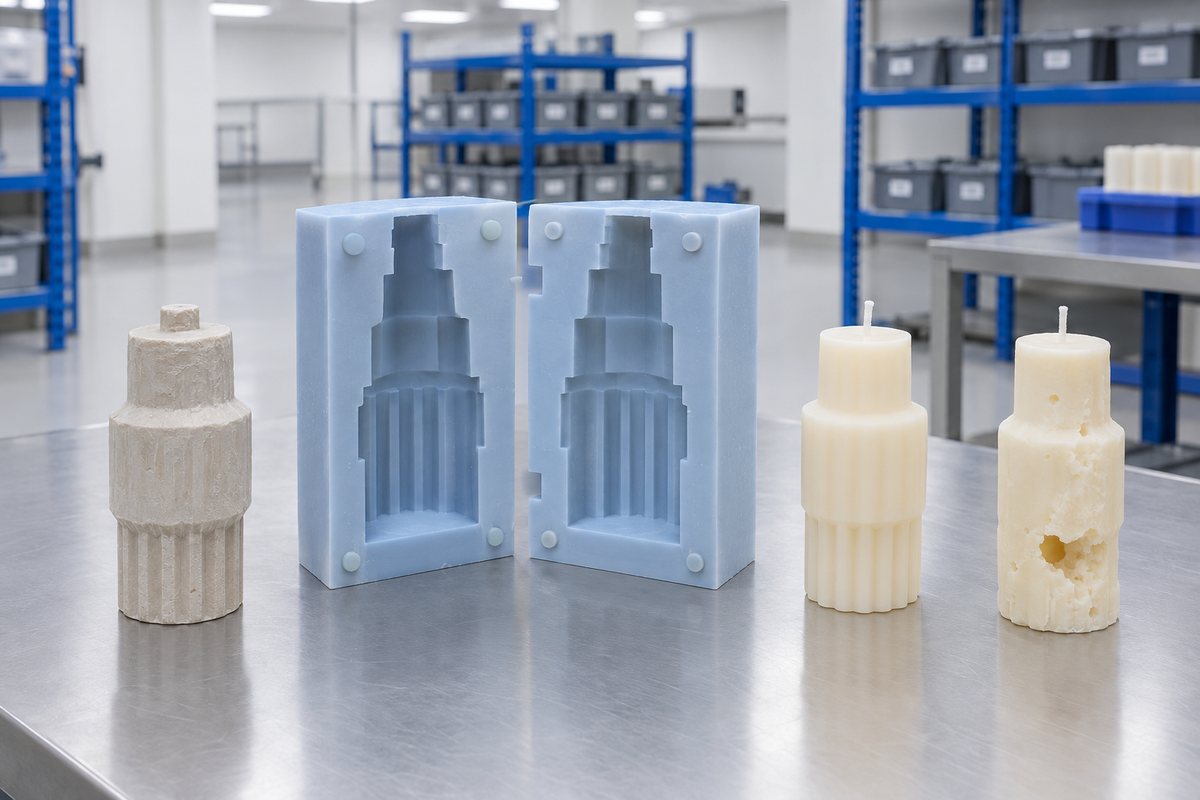
Illustrative example: Rough master pattern, silicone mould and flawed candle casting
Every flaw in the master repeats in the candle

Questions

Questions chandlers ask us about silicone

Can I tell platinum from tin cure by looking at a mould?

Not reliably. Colour is no guide, as both types come in every shade a manufacturer fancies. Age can offer a clue: a tin-cure mould that has been in service for a while usually feels stiffer and looks slightly chalky. The best way to be sure is to ask your supplier and keep the record for when you need a replacement.

Can I make a platinum mould from a tin-cure one?

Yes, but only with care, as residue from the older mould can inhibit the new cure. It is doable with proper sealing and a test patch first. Please tell us about it up front, rather than after a failed pour.

My mould has gone tacky in patches. Is it faulty?

Almost certainly not. This is cure inhibition: something on the master has interfered with a platinum cure. Identify the source, then seal or replace the master. Test a small patch before committing to the next pour.

Which should I choose for a trial mould?

Often, tin cure is a deliberate choice. If your shape is not settled and you expect to change it, a shorter-life tool is the rational purchase. Once the design has stopped moving, move to platinum for the production tooling. That is what prototype tooling is for.

Does the cure system change how the candle looks?

Yes, but subtly. Platinum holds fine surface texture for longer, helping a matte or grained finish stay consistent across a run. Tin cure loses that definition sooner, which you'll notice first on the crispest edge of the design.

How long will a mould last?

It is measured in pulls rather than calendar time, and the wax and pour temperature have more influence than chemistry. Every mould we make is covered against manufacturing defects, although normal wear is not a defect. If a tool fails early, we prefer to inspect it and tell you why. See replacement and spare moulds.

Scaling to a production run

At a glance

The idea in a picture.

Silicone hardness in everyday terms

00-30Gel insoleA10Jelly sweetA20Elastic bandA30Pencil rubberA40Shoe heelA60Tyre treadSofter: peels from undercutsFirmer: holds its shape

Swipe to see the whole diagram

A rough guide. We choose the grade for your shape, material and number of pours.

Ready to start?

Tell us what you pour and what the master is made of. We will pick the grade.

Send us a sample, a photograph or a sketch. We'll come back with a mould strategy, a material recommendation and a price.

Real people, a real workshop

You deal with the people who make it.

No call centre and no middlemen. When you contact TCI Mouldings, you speak to the team who design, build and check your mould.

  • A real Warwickshire workshopUnit 15, Waterloo Park, Bidford-on-Avon, Alcester B50 4JG.
  • Real people on the phoneCall the team on 01789 224228, Monday to Friday.
  • The same team on every jobDesign, production and aftercare come from the people you see here.
  • Part of TCI GroupFive specialist brands, one engineering team. Visit TCI Group.
The TCI design and project office.
A stack of TCI silicone moulds.
The TCI workshop, with moulds on the bench mid-build.
  • Thomas LaneManaging Director
  • George PrestonDesign & Project Manager
  • Kelly BallingerHead of Partnerships
  • Jim AndertonProduction Manager
  • TheodoreEmployee Welfare
Meet the team