A vessel-shaped candle mould
A two-part mould where the seam sat inside a decorative fin.
Read the recordProject record · Wholesale soap · Cast silicone at scale
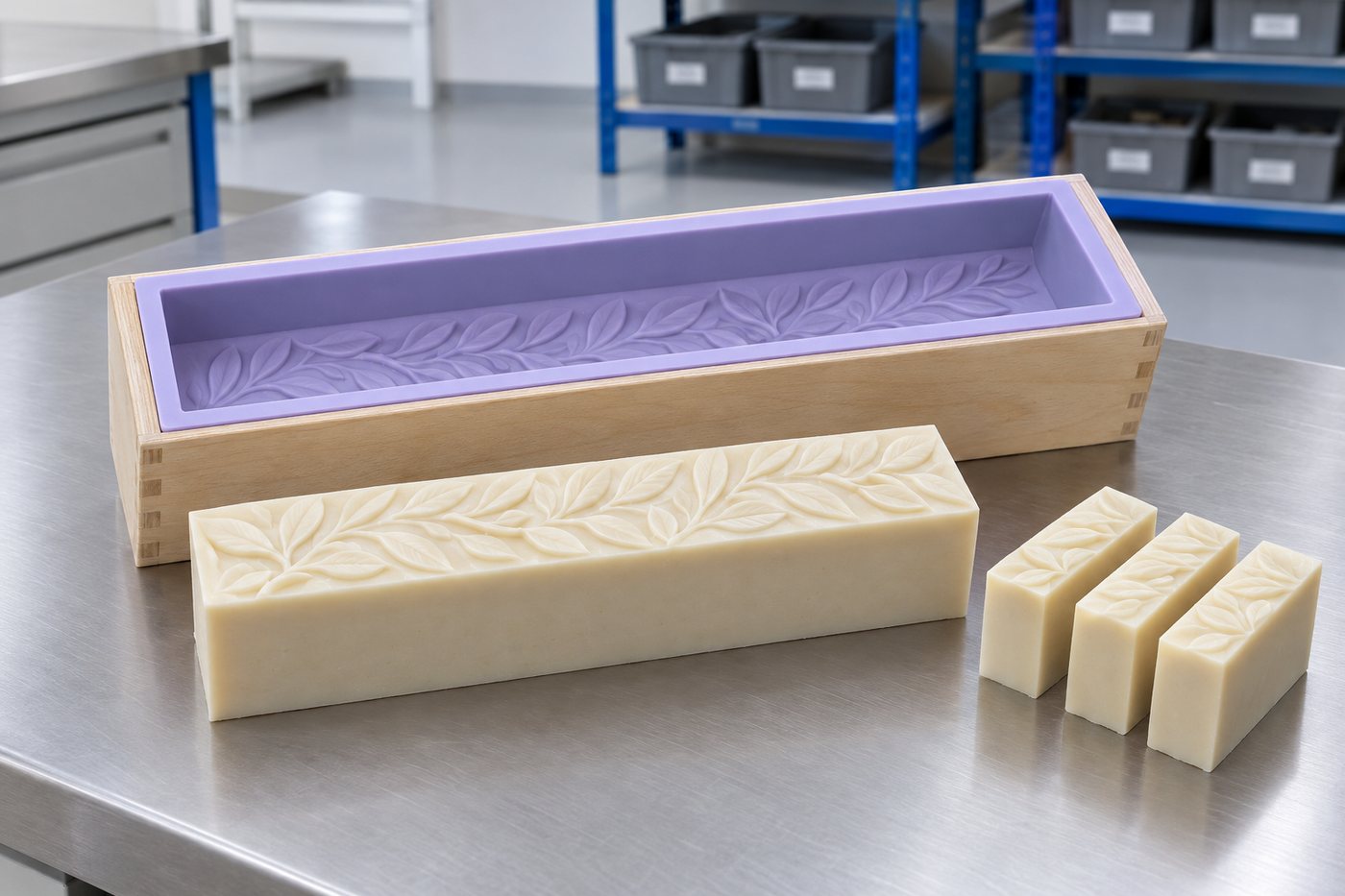
A wholesale soap maker was pouring cold-process loaves into wooden boxes lined with baking paper. They wanted a moulded silicone loaf mould that took the same volume, released cleanly, and left a subtle brand mark on the base of every bar.
The brief
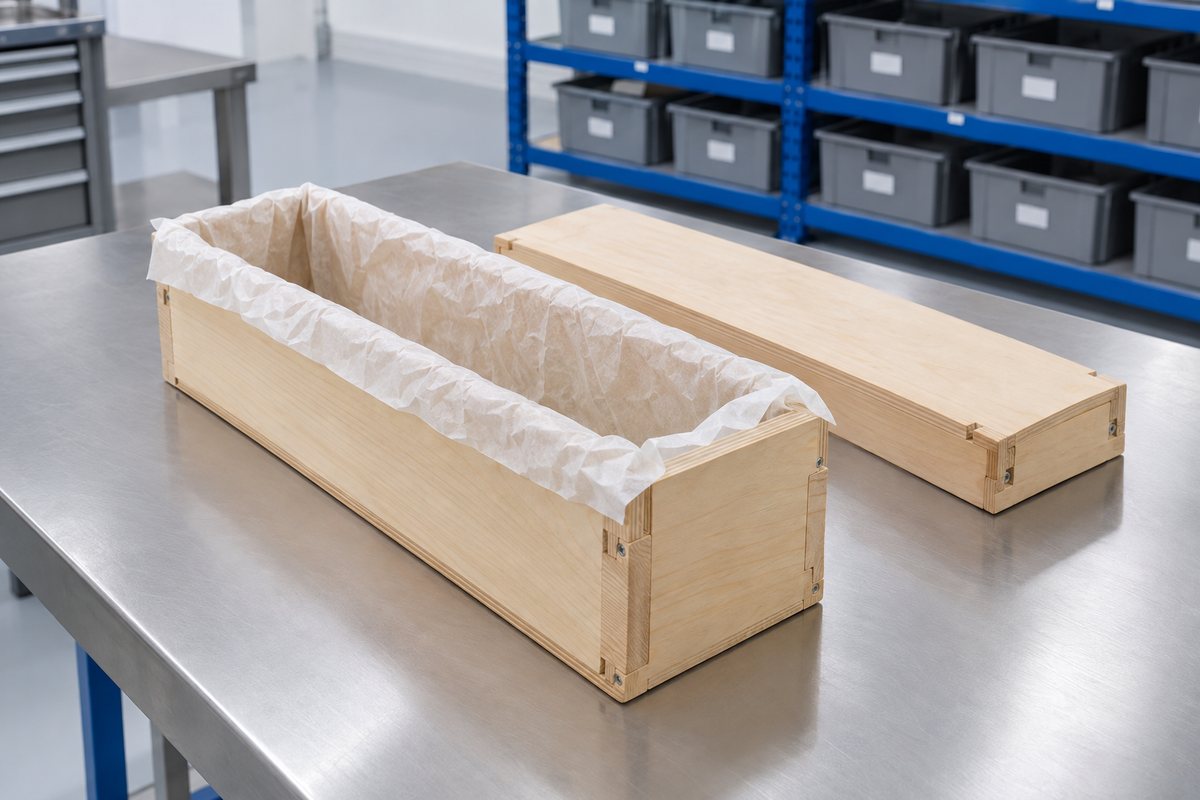
A wholesale soap maker was pouring 2 kg cold-process soap loaves into hand-built wooden boxes lined with baking paper. Wooden boxes work at hobby scale. At their volume, the paper wrinkled, the box corners bulged, and every fifth loaf had to be trimmed at the ends to bring it back to size.
They wanted a moulded silicone loaf mould that took the same volume, gave them the same square-ended loaf, and stopped the trim waste. On the base of each loaf, they wanted their brand mark to appear as a shallow moulded relief, so the sliced bars carried the mark on the back face.
The loaves cured for four days before slicing. The mould had to release cleanly, hold its shape through the cure without bulging, and survive being knocked out over a slicing table twenty times a shift.
The problem
Cast silicone is flexible. That is its great strength for release, and its great weakness for holding shape. A 2 kg loaf of curing soap generates hydraulic pressure sideways on the mould walls. Without support, the walls bow, and the finished loaf is barrel-shaped rather than square.
The obvious answer is to make the silicone wall thick. Thick silicone is expensive, heavy to handle, and does not solve the problem — it just delays the bulge until the loaf is a bit bigger. The real answer is to give the silicone a rigid outer sleeve that carries the load.
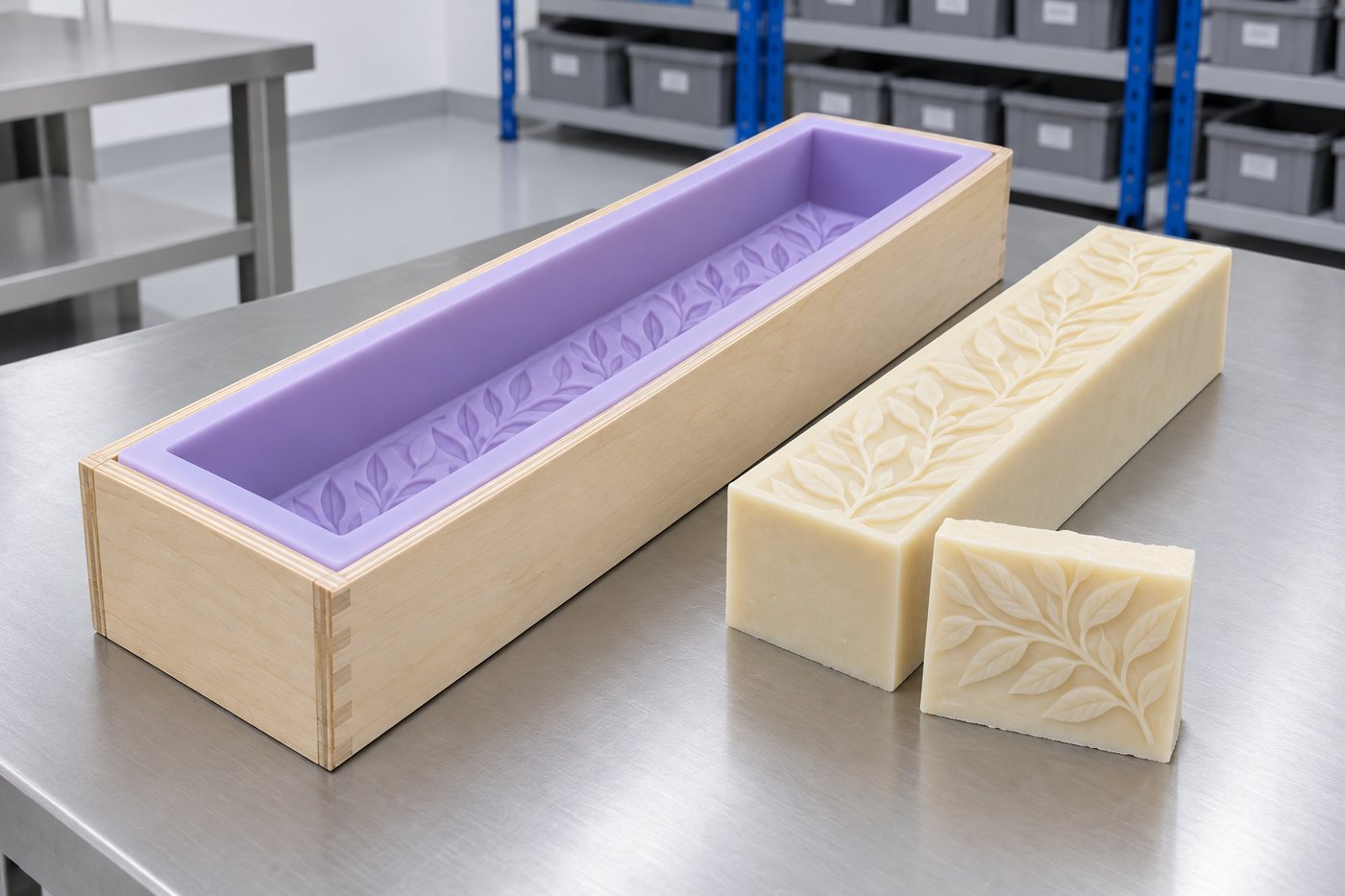
The base relief added a second problem. Relief on the base of a soap mould has to release with the loaf, not stay in the mould. Cold-process soap gets slightly sticky before it fully cures. Draft angle on every letter is not a nicety, it is the difference between a clean release and a torn base.
Illustrative schematic. Real tools include additional detail (runners, vents, ejector positions).
What we did
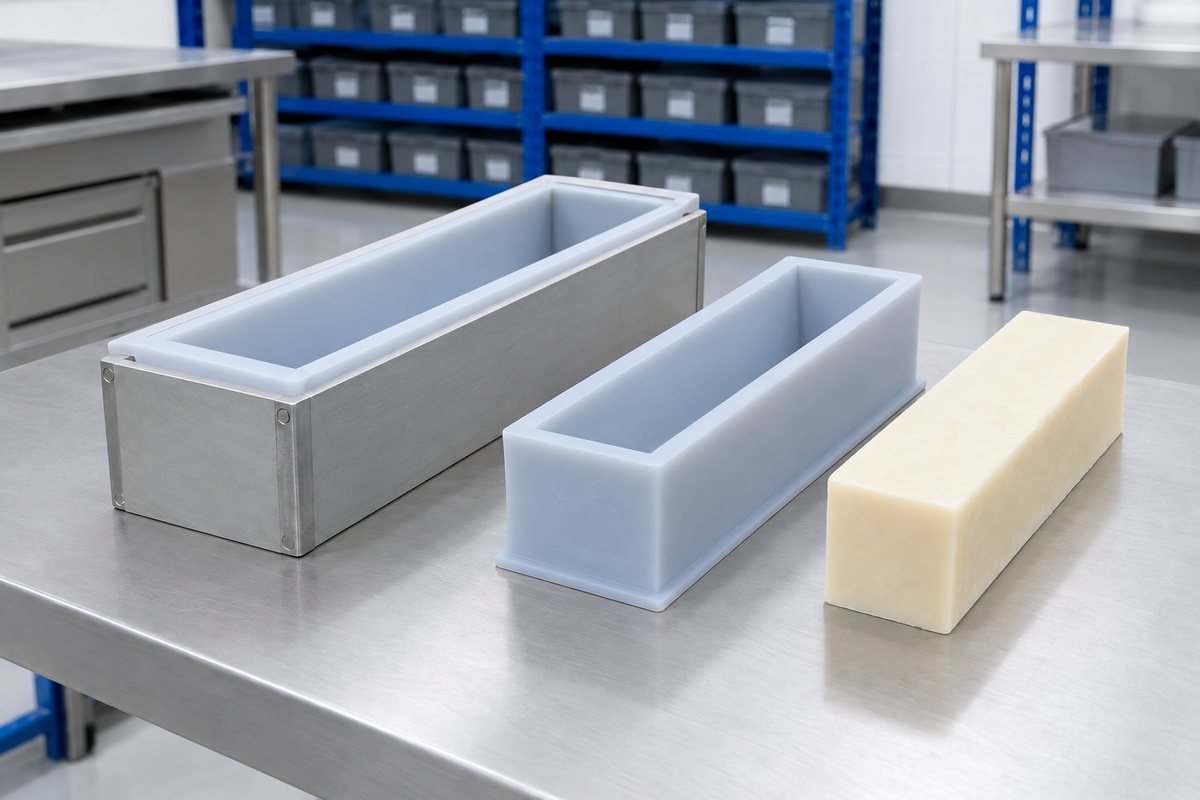
The mould is a two-part system: the silicone gives the release, the sleeve gives the shape.
The silicone inner and the rigid outer sleeve were designed as one system. The sleeve is a laser-cut MDF box with cross-braces. The silicone drops into it and takes its shape from it, not from the soap.
The base relief — the brand wordmark and a small production date pocket — was CNC-cut from a food-safe polymer master, with 3 degrees of draft on every letter wall.
Platinum-cure silicone was cast around the master and inside a former that shaped the outside to fit the sleeve. Wall thickness was set at 8 mm — enough to release cleanly, not so much as to be wasteful.
First-off loaves were poured with the maker's own soap recipe, not a plaster stand-in. Plaster releases differently. Real soap tests real release, real shrinkage, real bulge.
The sleeve was given routed finger cutouts along the top edge, so the mould can be lifted out of the sleeve one-handed once the loaf has cured. Small detail, saves a minute per loaf across a shift.
The mould shipped as a set — silicone inner, rigid sleeve, care sheet, and one spare inner. Cold-process soap eventually degrades any silicone. The spare is there so the run does not stop when the primary reaches end of life.
The stages
Drag the timeline left and right, or use the arrow keys. Each stage explains what happens and roughly how long it takes.
Drag · tap a stage for detail
Total working time on a job of this shape: about 4 weeks (26 working days). Lead times shift with drawing changes, sign-off pace and material availability.
The commercial bit
Rather than quote a figure that would only be right for one job, here is a worked example based on a realistic project of this shape. Your quote follows the same shape, with your part, your volume and your material.
A wholesale soap maker pouring 40 loaves a week over a two-year mould life.
| Master pattern + sleeve design | £1,150 one-off |
|---|---|
| Silicone inner + spare inner | £980 for the pair |
| Rigid MDF sleeve | £320 one-off |
| Tool amortised over 4,000 loaves | ≈ £0.61 per loaf |
| Per bar (14 bars per loaf) | ≈ £0.04 per bar |
Numbers are indicative for a 2 kg loaf with a moulded base wordmark. Cold-process soap eventually degrades silicone, hence the spare inner in the base package.
We lost the trim step entirely. Every bar we cut off a loaf now is a bar we sell.
Owner, wholesale soap company
Where it landed
Every project record on this site is a real piece of work delivered to a real client, with the tooling and the numbers to back it up. This one is no exception.
If you have a similar problem, please send a drawing or a photograph. We will come back with a route, a lead time, and an indicative cost.
More records
A two-part mould where the seam sat inside a decorative fin.
Read the recordTapered wall silicone tool for repeat pillar production.
Read the recordNext step
Send us the volume you pour, the recipe, and a photograph of what you're pouring into today. We'll come back with a mould design that fits your bench, releases cleanly for your specific soap, and takes a subtle brand mark on the base if you want one.
If you're currently trimming loaf ends because your existing moulds bulge under load, that's a mould-system problem, not a soap problem. The fix is a rigid sleeve around a silicone inner. It changes the finished loaf shape entirely.
At a glance
Which route suits your quantity
Swipe to see the whole diagram
Ready to start?
Send us a drawing, photograph or sample, and we'll come back with a route, a material recommendation and a price.
Real people, a real workshop
No call centre and no middlemen. When you contact TCI Mouldings, you speak to the team who design, build and check your mould.

 Thomas LaneManaging Director
 George PrestonDesign & Project Manager
 Kelly BallingerHead of Partnerships
 Jim AndertonProduction Manager
 TheodoreEmployee Welfare