
Stone
Carved stone and cast stone
Moulds for finials, corbels, balusters, crockets and capitals cast in reconstituted stone.
Industries · Heritage restoration and conservation
Silicone and supported rubber moulds that replicate carved stone, ornamental plasterwork, terracotta, faience, cast iron and timber details, so lost or decayed elements can be replaced to match. For conservation architects, restoration contractors, cathedrals, estates and heritage bodies.
What restoration teams need

Restoration work is judged by whether the new piece can be told apart from the old. It has to carry the same profile, the same carving and, often, the same wear.
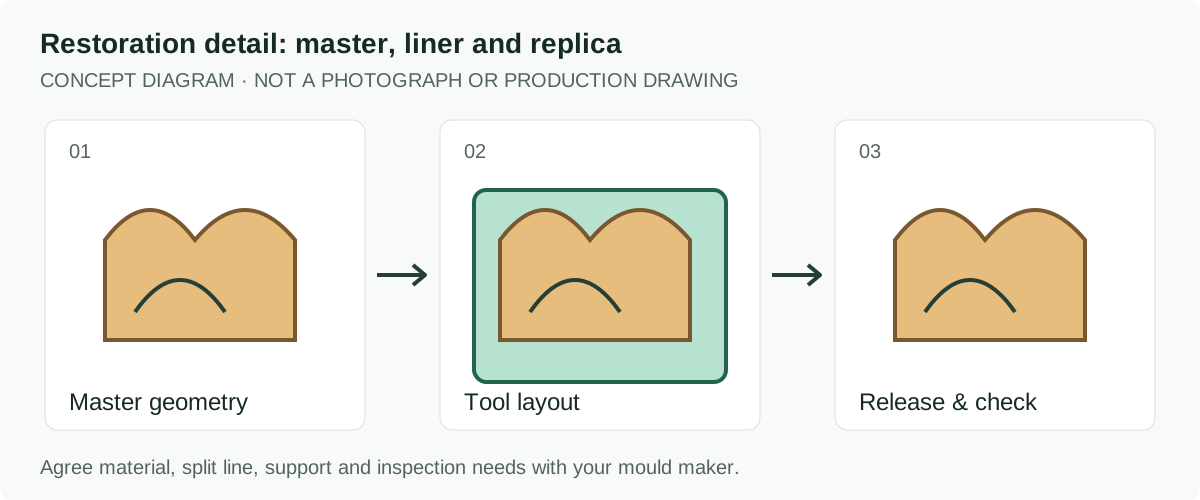
We take moulds from surviving elements on the bench or in situ, using methods agreed with your conservation architect, or work from 3D scans and reconstruct missing detail from drawings and photographs. The production mould then casts replacements in stone, lime, plaster, terracotta or resin.
We keep your masters and drawings on file, so future repairs to the same building match too.
Typical heritage work
Six families of tooling cover most enquiries in this industry.
Moulds for finials, corbels, balusters, crockets and capitals cast in reconstituted stone.
Moulds for cornices, ceiling roses, enrichments and panel mouldings in fibrous plaster.
Moulds for press-moulded and slip-cast replacements of facade blocks and tiles.
Patterns for replacement railings, brackets, rainwater goods and plaques.
Moulds for resin or composite replicas of carved timber where originals cannot be replaced like for like.
Moulds from memorials, effigies and statuary for repair or protective replicas.
Parts and tooling
A general guide. Geometry, material and volume decide the final tool.
Typical guide values, confirmed on your quotation. We confirm grade, tool life and lead time against your part and process.
| Element | Typical mould | Typical casting | Why it matters |
|---|---|---|---|
| Stone carving | Supported silicone | Reconstituted stone, lime | Undercut carving released intact |
| Cornice and enrichment | Long silicone run moulds | Fibrous plaster | Lengths match and join cleanly |
| Terracotta block | Plaster or rubber press mould | Terracotta, faience | Shrinkage allowed for in the mould |
| Railings and castings | Pattern from original | Cast iron, bronze | Profile matches the surviving run |
| Statuary | Multi-part silicone with jacket | Stone, resin, bronze | Faithful surface and wear |
Send the drawing, the material and the quantities with your enquiry so we can confirm the route before quoting.
Examples
Eight typical jobs for silicone, polyurethane and rubber tooling in this industry. Each one can be a single development tool or a full production set.
Moulds from surviving carvings for matching cast stone.
SiliconeRun and cast plaster details for listed interiors.
Silicone, PUMatching balusters, finials and urns for parapets.
Silicone, supported PUCarved figures recast where originals are failing.
Silicone, jacketedMoulds for replacement terracotta and faience blocks.
Plaster-backed siliconePatterns for railings, panels and fittings recast in iron.
Silicone, PULettering and detail for war memorials and monuments.
SiliconeMasters from 3D scans where originals cannot be touched.
Printed master, siliconeTooling ideas, clearly explained
Larger customers ask the same questions: how is it checked, what is it made from, and can you make another one exactly the same? This is how we answer them.


Photos: Brandable Box, Jessica Streser, Wilhelm Gunkel, laura adai on Unsplash.
How we work
Please contact us before sending sensitive drawings or samples so that any confidentiality arrangements can be agreed.
You have a named contact for your programme, from feasibility to repeat supply, and is the person your engineering, quality and procurement teams speak to.
Material documentation, inspection requirements, manufacturing responsibilities and any necessary approvals should be specified and confirmed for your project before work is authorised.
Any tooling-specific terms, expected service conditions and remedies must be confirmed in your written quotation and order agreement.

Programme stages
We review the part, the material, the quantities and the deadline, and propose the tooling.
Please contact us before sending sensitive drawings or samples so that any confidentiality arrangements can be agreed.
Master made from your CAD, scan or original, and the first tool trialled.
Fit, finish and release tuned from the trial before tools are duplicated.
Matched sets, planned replacements and archived masters.
Common questions
Yes, where access and the conservation method allow. We agree release agents and methods with your conservation architect before work starts.
We scan it at high resolution and produce a master from the scan, reconstructing missing detail from drawings and photographs where needed.
No. We make moulds and supply castings through partners, and work alongside your restoration contractor.
Pricing depends on your design, materials, quantities and tooling scope. Ask us for a quotation against your project brief.
Related industries

Tooling for cast polyurethane and elastomer parts in offshore wind, oil and gas, subsea and grid infrastructure: bend restrictors, cable protection, buoyancy and seals.
Read more
Tooling for seals, gaskets, interior trim, composite panels and low-volume parts for rail, bus, coach, defence and specialist vehicle manufacturers.
Read more
Moulds for soft robotic grippers, vacuum cups, finger pads, bellows and protective covers for robot makers, integrators and automated production lines.
Read moreStart a programme
We will propose the moulding method, the casting material and a fixed programme price.
Your project, our expertise
Contact TCI Mouldings with your drawings, samples and production requirements so the technical brief and next steps can be discussed.


 Thomas LaneManaging Director
 George PrestonDesign & Project Manager
 Kelly BallingerHead of Partnerships
 Jim AndertonProduction Manager
 TheodoreEmployee Welfare