A pillar candle mould that flexed for release
Tapered-wall pillar with a hinged aluminium sleeve.
Read the recordProject record · Home fragrance · Multi-cavity cast silicone
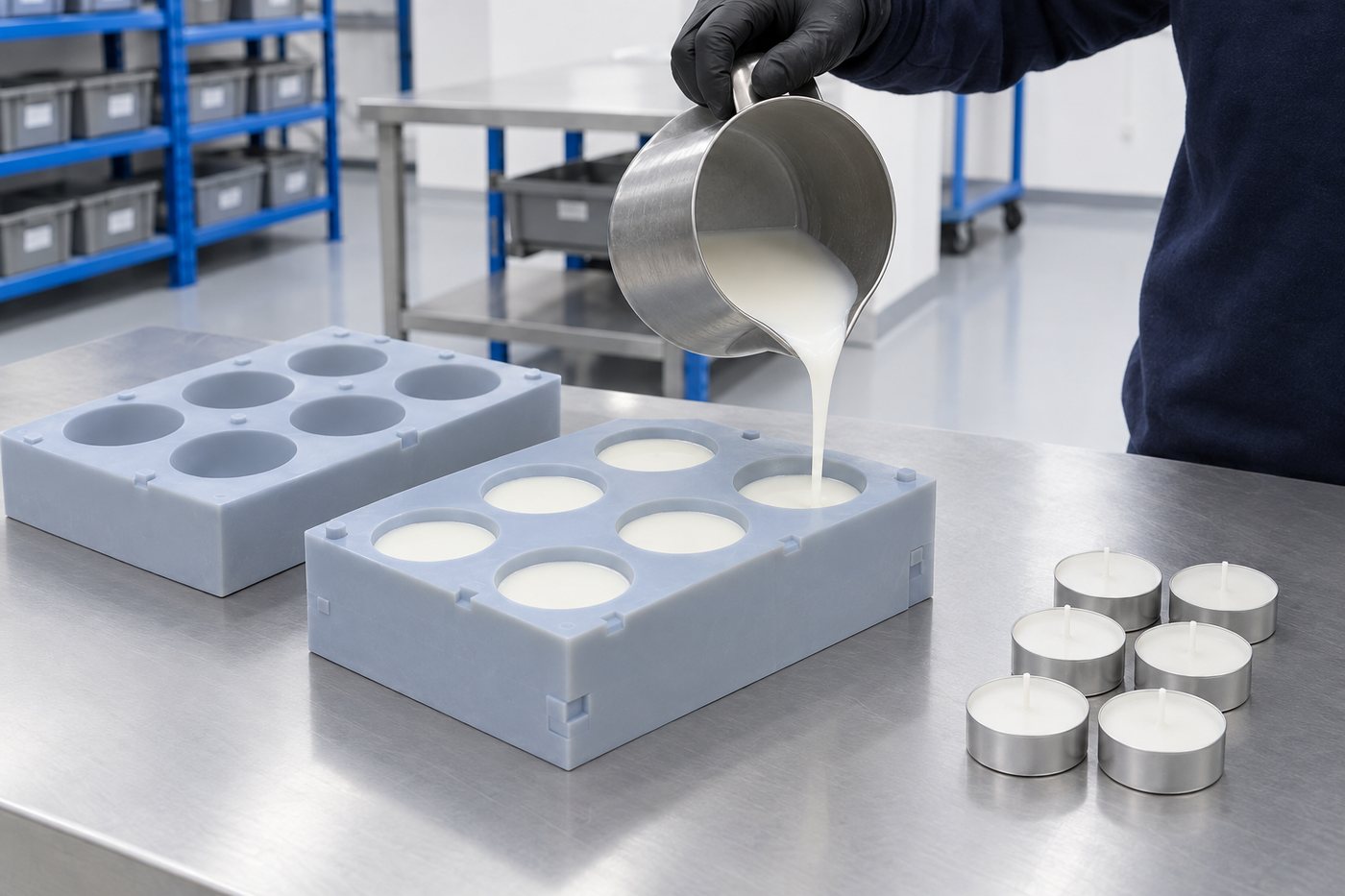
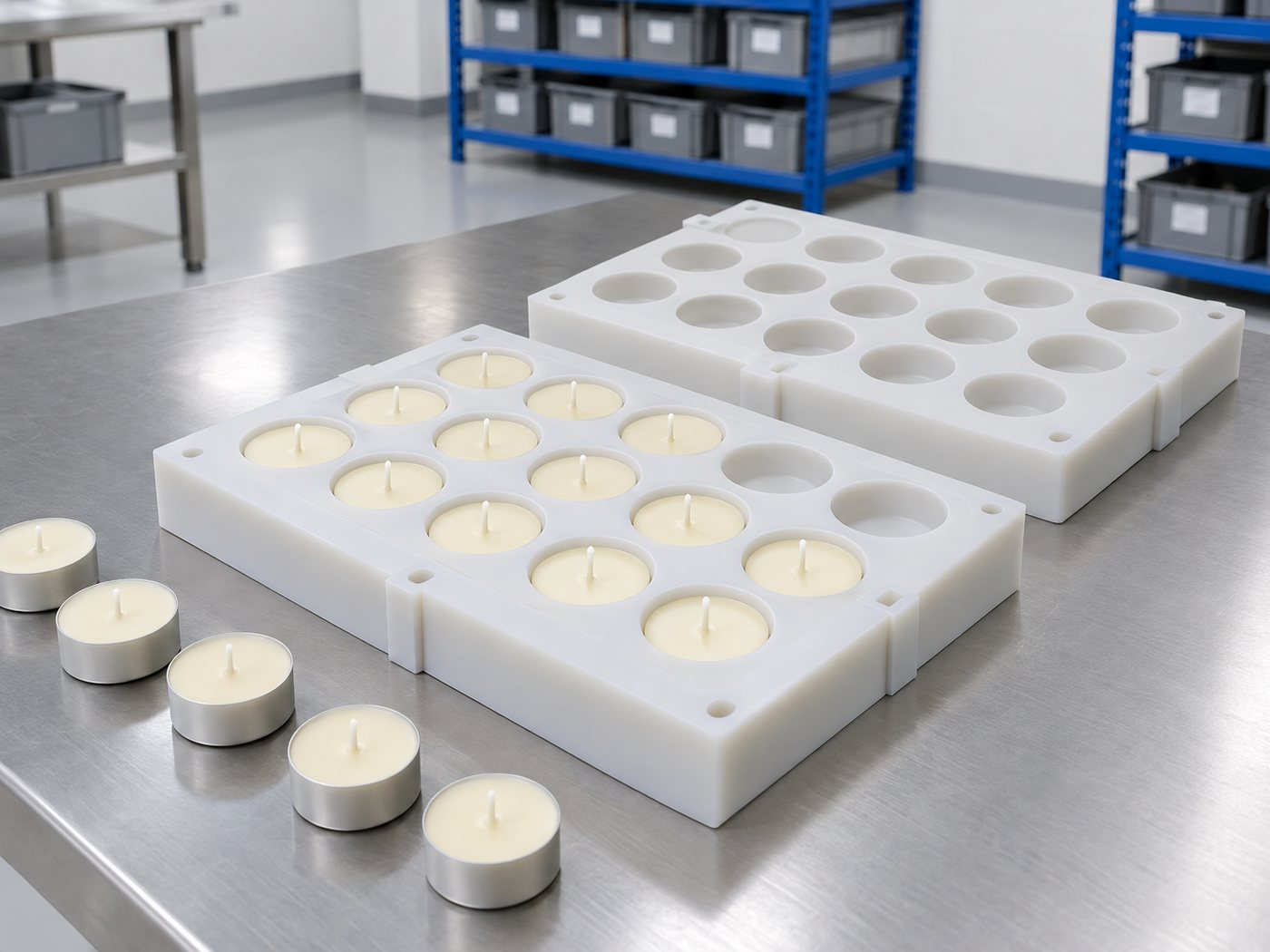
A home-fragrance brand was pouring tealights into a rack of individual metal cups. The rack pour worked, but was slow, cluttered the bench, and stopped them scaling. They wanted a single mould that gave the same result in a single pour.
The brief
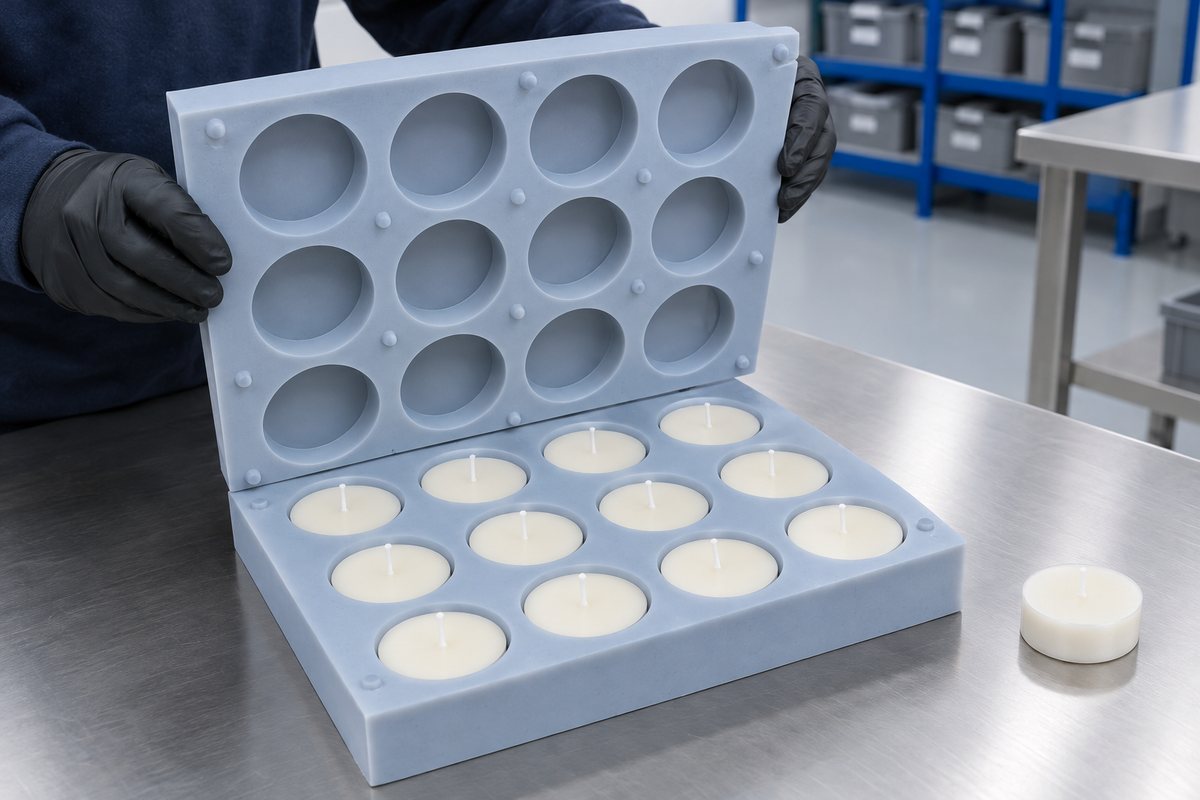
The brand was buying 20-tealight racks of individual aluminium cups. They poured wax into the rack, added wicks, waited, then popped the tealights out one by one. It worked for a hobby scale. At their new wholesale volume, it dominated the working day.
They wanted a single mould with 20 cavities that took the same pour volume, gave the same tealight shape, and could be turned out over a tray in one operation.
The mould had to be food-grade silicone — one of the brand's product lines was scented but food-safe — and had to hold cavity-to-cavity level, so every tealight came out at the same volume without needing individual top-ups.
The problem
The problem with a multi-cavity flexible mould is level. If any cavity sits even a millimetre lower than its neighbours, wax flows across the surface until the low cavity fills to the brim of the taller ones. That cavity ends up with a proud finish; the others end up short.
The obvious fix is to make the mould rigid. Rigid moulds solve level and lose release. Every tealight sticks to a rigid mould, and every tealight has to be pushed out with a plunger, which we were trying to avoid at 20 cavities per shift.
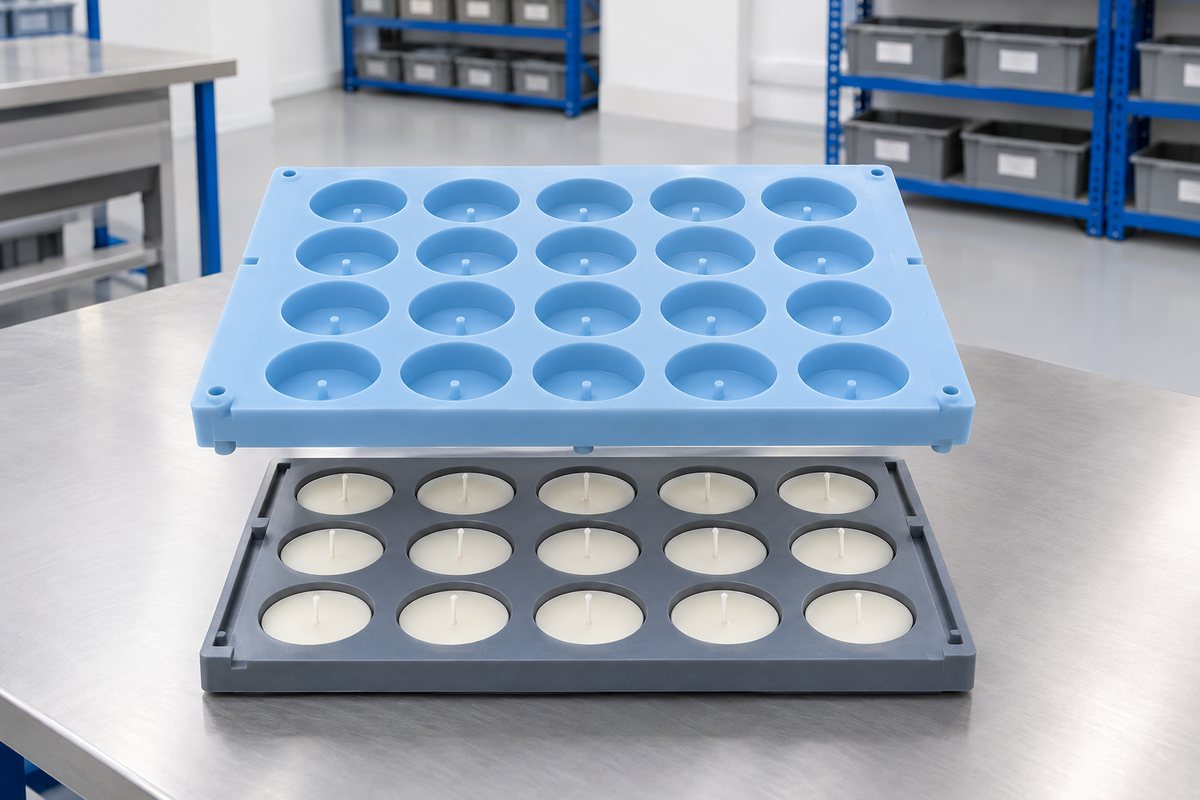
The real answer is a silicone mould supported on a purpose-built rigid tray. The silicone gives release. The tray keeps every cavity at the same height. The mould inverts over a slotted board, and 20 tealights drop into their receiving slots at once.
Illustrative schematic. Real tools include additional detail (runners, vents, ejector positions).
What we did
Everything about this mould is designed so it comes out of it in one movement.
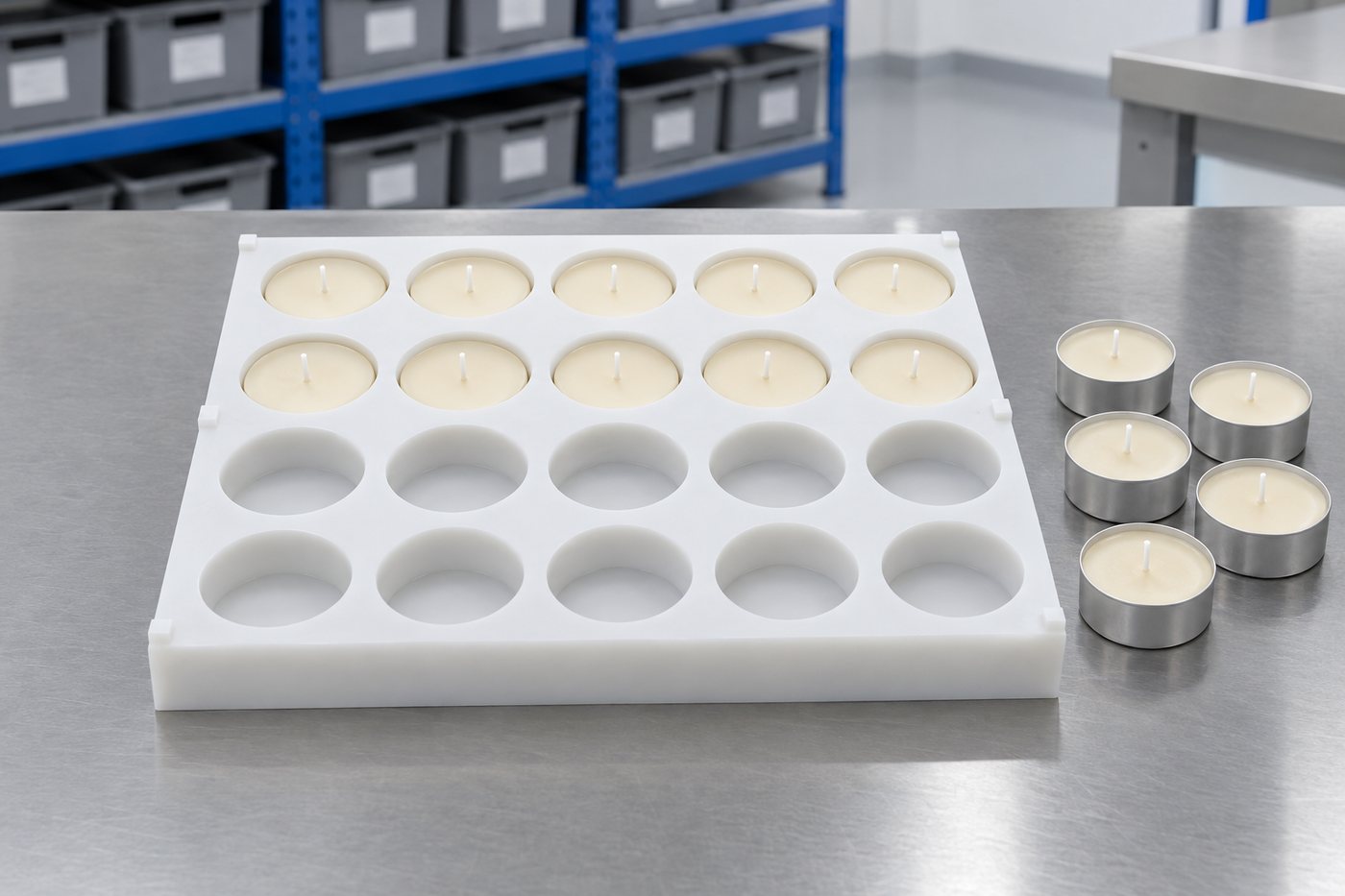
Cavity layout was matched exactly to the brand's existing packaging tray. Twenty cavities in a 4 × 5 grid, spaced so the moulded tealights drop straight into the retail tray.
A single machined pattern was replicated 20 times to make the master. Cavity-to-cavity variation is measured in hundredths of a millimetre, well inside what matters for wax.
Food-grade platinum-cure silicone was cast over the 20-cavity master, giving a 10 mm base under the cavities and 8 mm walls between them.
An aluminium tray with the same 4 × 5 grid was cut to receive the silicone mould. The tray supports the mould level during pour and forms the reference plane for cavity height.
A slotted receiving board was built for release. The mould inverts over the board, the tray lifts off, and the tealights drop into the slots. No tealight is handled individually.
Sign-off pour was done with the brand's own wax, at their own pouring temperature. Twenty tealights out in one operation, all level, all wicked, ready to go straight to a retail tray.
The stages
Drag the timeline left and right, or use the arrow keys. Each stage explains what happens and roughly how long it takes.
Drag · tap a stage for detail
Total working time on a job of this shape: about 3 weeks (21 working days). Lead times shift with drawing changes, sign-off pace and material availability.
The commercial bit
Rather than quote a figure that would only be right for one job, here is a worked example based on a realistic project of this shape. Your quote follows the same shape, with your part, your volume and your material.
A brand pouring three racks a day, five days a week, over an 18-month mould life.
| Master pattern + CAD | £1,450 one-off |
|---|---|
| 20-cavity silicone mould | £1,200 one-off |
| Aluminium tray + receiving board | £680 one-off |
| Tool amortised over 23,400 tealights | ≈ £0.14 per tealight |
| Wax, wick, fragrance | your existing cost |
Numbers are indicative for a standard 38 mm × 18 mm tealight cavity, food-safe silicone. Larger cavities push tooling up moderately.
Twenty tealights out in one operation. That's the day back.
Production manager, home fragrance brand
Where it landed
Every project record on this site is a real piece of work delivered to a real client, with the tooling and the numbers to back it up. This one is no exception.
If you have a similar problem, please send a drawing or a photograph. We will come back with a route, a lead time, and an indicative cost.
More records
Tapered-wall pillar with a hinged aluminium sleeve.
Read the recordNext step
Send us the cup geometry, the number you pour at a time, and what tray or box the finished product ends up in. We'll come back with a single-mould layout that pours the same number in one operation.
If you're paying labour for the pop-out step on individual tealights, votives or wax melts, that step disappears with an invert-and-release rig. The saving is usually in the shift time, not the material.
At a glance
Which route suits your quantity
Swipe to see the whole diagram
Ready to start?
Send us a drawing, photograph or sample, and we'll come back with a route, a material recommendation and a price.
Real people, a real workshop
No call centre and no middlemen. When you contact TCI Mouldings, you speak to the team who design, build and check your mould.


 Thomas LaneManaging Director
 George PrestonDesign & Project Manager
 Kelly BallingerHead of Partnerships
 Jim AndertonProduction Manager
 TheodoreEmployee Welfare