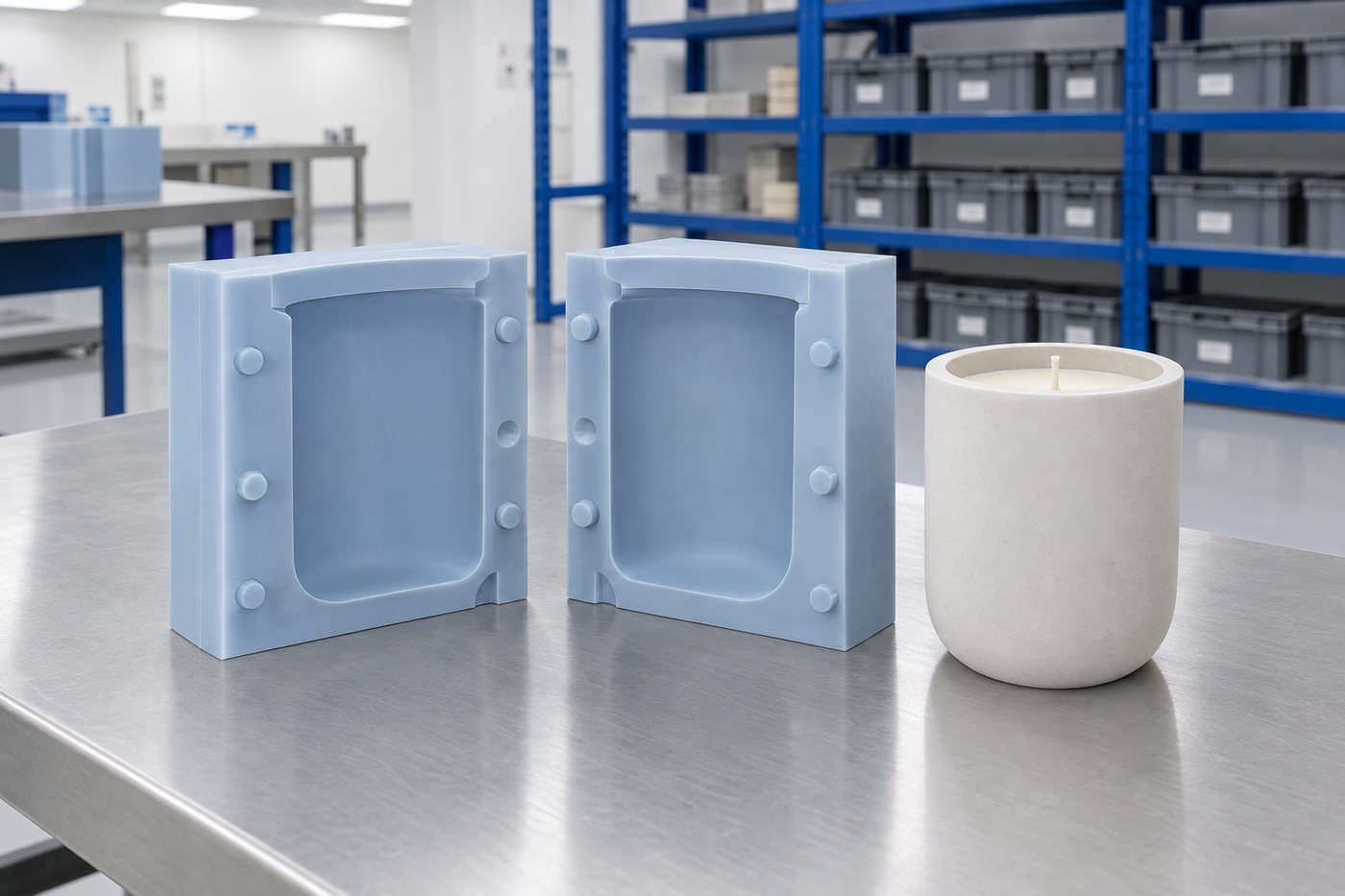
A mould that pours 2 kg at a time
A large soap loaf mould where the seam had to sit under the cutting line.
Read the recordProject record · Home fragrance · Two-part silicone tool
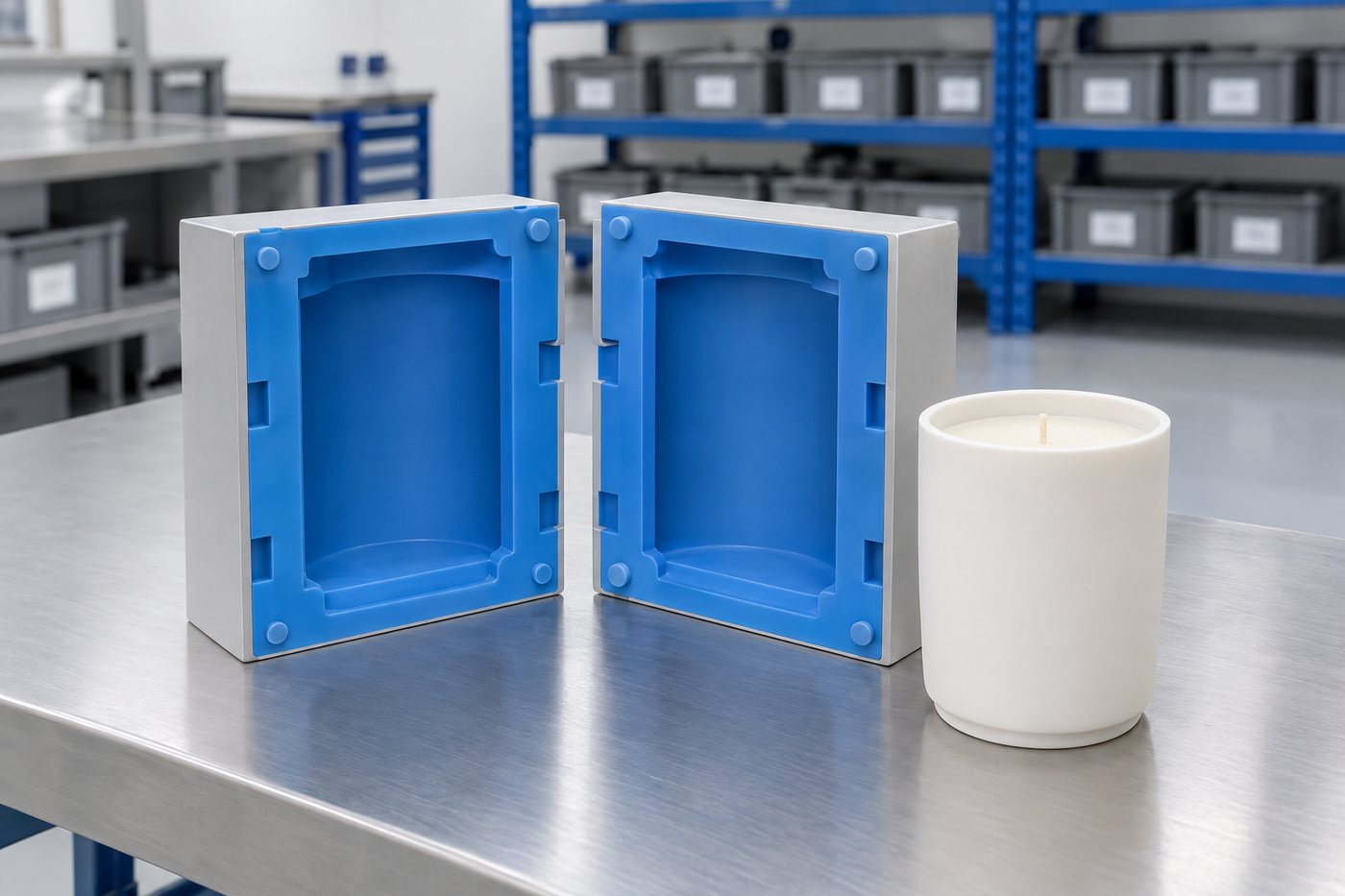
The brand wanted a fragrance candle whose outer vessel was also its packaging. That meant a two-part silicone mould that could release a doubly curved shape with a decorative fin, without leaving a seam anyone would run a thumb over.
The brief
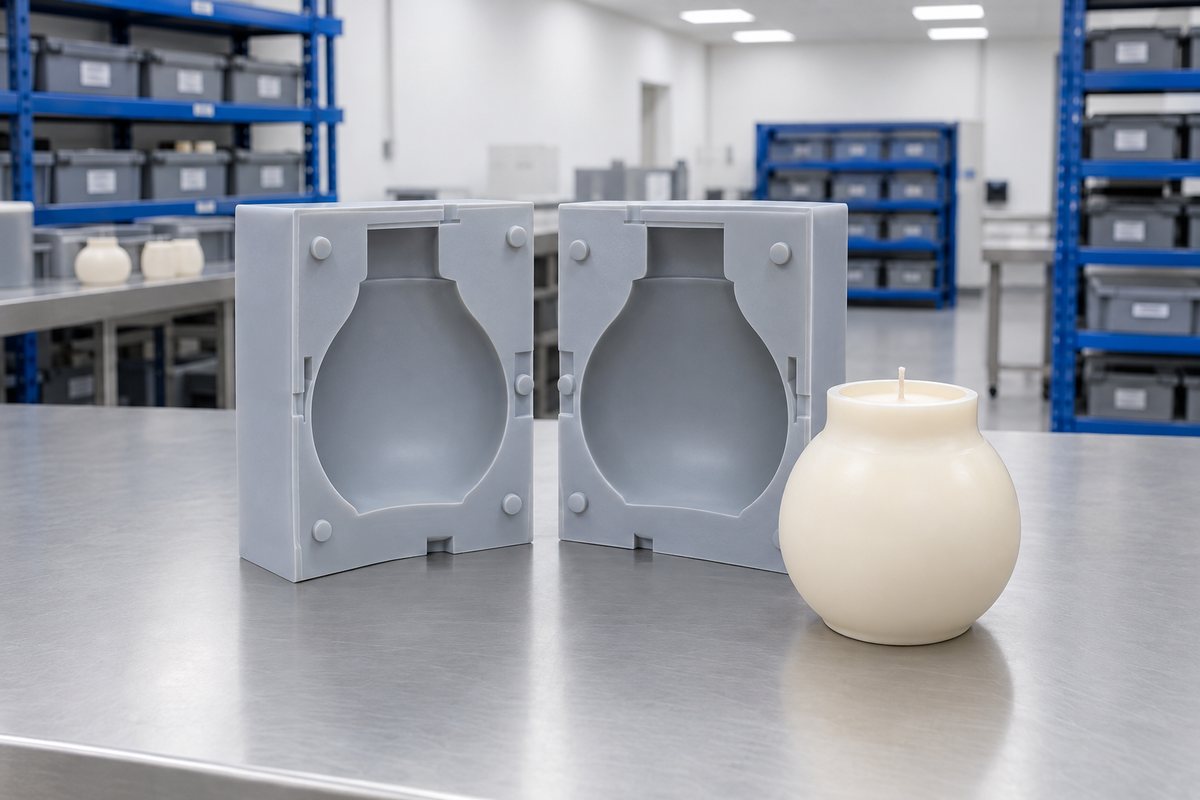
A home-fragrance brand had a candle line built around a signature vessel — a curved, tulip-shaped container with a fine collar. Their previous supplier had made the vessel in glass. The margin was thin, and every third piece failed inspection because of seam lines.
They wanted to move the vessel into a poured mineral wax, cast the vessel and candle in one operation, and drop the glass entirely. That put the mould onto us.
The problem was that the vessel was doubly curved, meaning it bulged outward in two directions at once, and had a decorative fin running down one side. Doubly curved parts cannot be cast in a single-piece mould. Fins cannot be cast without a split. The mould had to be a two-part tool from the start.
The problem
Two-part moulds always leave a seam. On a candle vessel, the seam is where the eye lands. It runs from the base to the rim, straight down the display side of the piece. Getting a good vessel out of a two-part mould is a matter of putting the seam where it can be lived with.
On this piece, the decorative fin was already a vertical line down one side of the vessel. If we could get the seam to sit exactly on the fin, then any residual mark would look like part of the fin's edge, not like a manufacturing defect.
Alignment between the two halves is the other half of the problem. Half a millimetre of misalignment shows up as a step across the fin, and every candle in the run inherits the same step. The alignment had to be built into the mould itself, not left to whoever poured it.
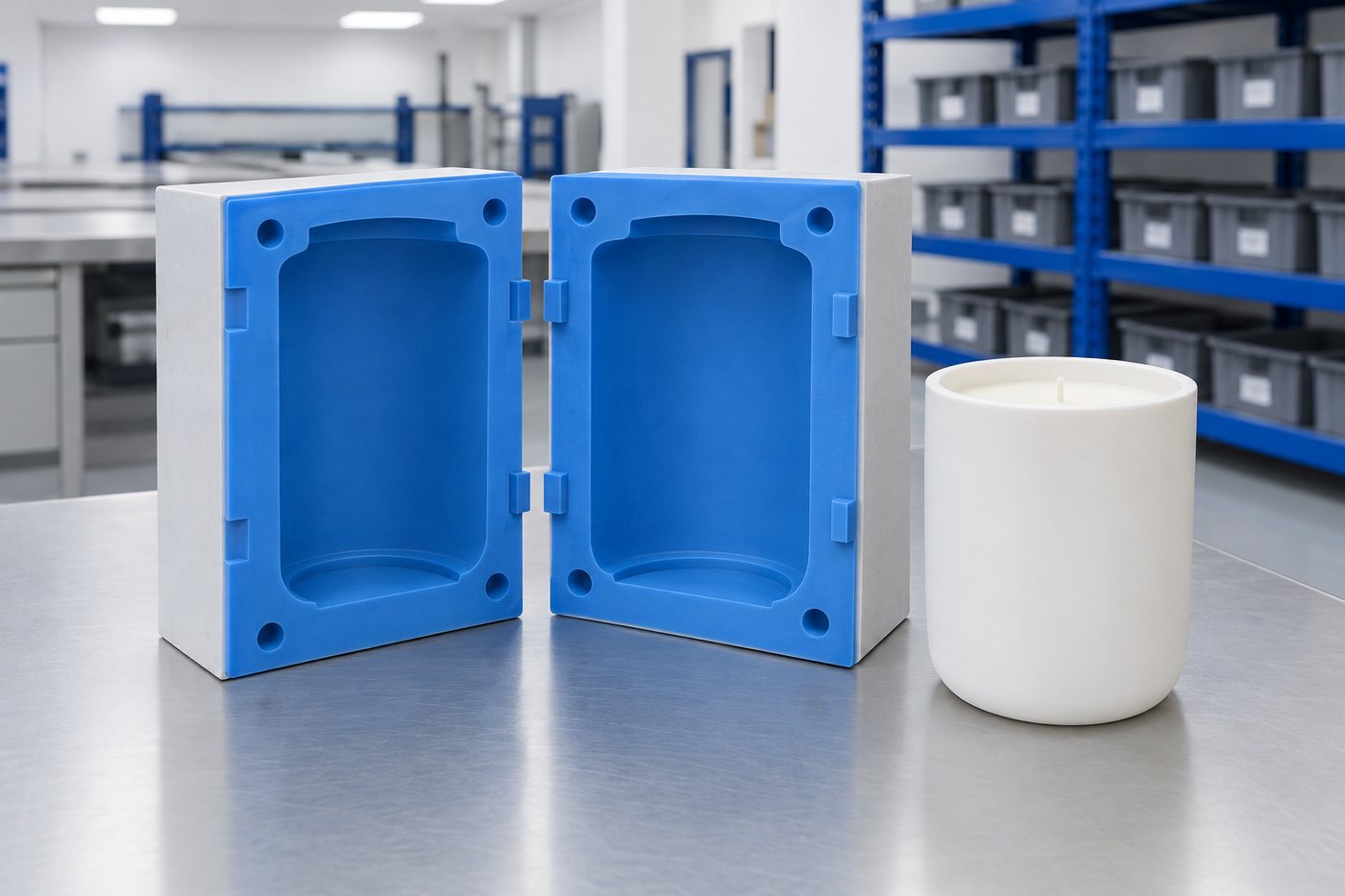
Illustrative schematic. Real tools include additional detail (runners, vents, ejector positions).
What we did
Casting a doubly curved vessel is really an alignment problem dressed up as a geometry problem.
Before any silicone was mixed, the vessel was modelled in CAD with the split line running down the display fin, and the fin thickened by 0.3 mm to give the seam somewhere to sit.
The master was CNC-cut in a rigid foam-core polymer, hand-finished to remove tool marks. Foam-core keeps the master light, which matters when you are casting silicone over it.
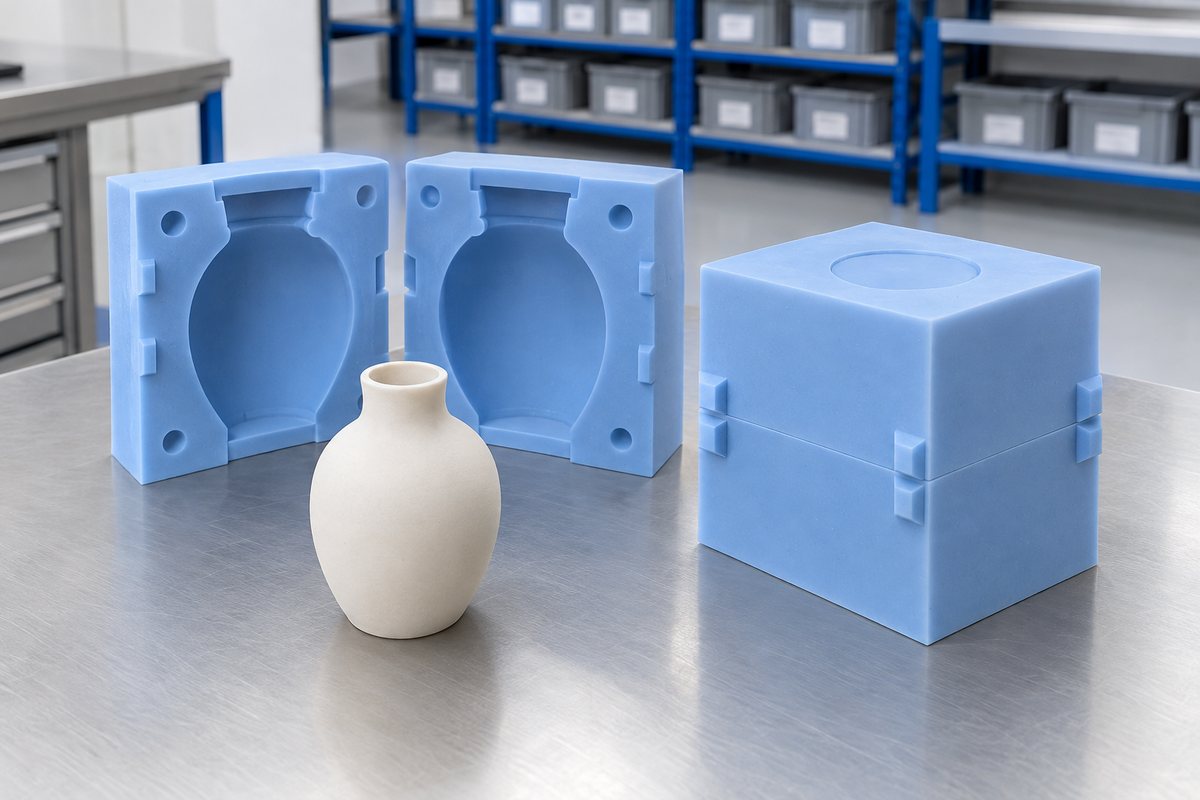
The master was set fin-up in a card box. The first half of the silicone was poured to the split line, keys were embedded on the parting face, and cured overnight.
With the first half still in place, the box was inverted, and the second half was cast onto the first. The keys pulled in registration, so the halves sit together in one position and only one position.
The two halves were split, the master removed, and the mould poured with wax. First candles were reviewed under raking light — the light that catches every seam. The seam sat inside the fin, invisible.
The brand runs the moulds in matched pairs so they can decant, pour and cool in parallel. Both moulds shipped with keys aligned, plus a laminated pour-order card for the bench.
The stages
Drag the timeline left and right, or use the arrow keys. Each stage explains what happens and roughly how long it takes.
Drag · tap a stage for detail
Total working time on a job of this shape: about 4 weeks (25 working days). Lead times shift with drawing changes, sign-off pace and material availability.
The commercial bit
Rather than quote a figure that would only be right for one job, here is a worked example based on a realistic project of this shape. Your quote follows the same shape, with your part, your volume and your material.
A candle brand pouring 200 vessels a week from a matched mould pair over an 18-month product cycle.
| CAD + master pattern | £1,650 one-off |
|---|---|
| Matched mould pair (two moulds) | £1,950 one-off |
| Tool amortised over 15,000 vessels | ≈ £0.24 per vessel |
| Wax, wick, fragrance | your existing cost |
| Landed tool cost per vessel | ≈ £0.24 |
Numbers are indicative for a 240 ml doubly curved vessel with a single decorative fin. Add £950 if a second mould pair is required for redundancy.
The vessels come out of the mould looking like they came out of a glass blower. We stopped inspecting for seams after the third batch.
Production manager, home fragrance brand
Where it landed
Every project record on this site is a real piece of work delivered to a real client, with the tooling and the numbers to back it up. This one is no exception.
If you have a similar problem, please send a drawing or a photograph. We will come back with a route, a lead time, and an indicative cost.
More records
A large soap loaf mould where the seam had to sit under the cutting line.
Read the recordHow the mould released a shape with no straight sides at all.
Read the recordFine relief on a curved silicone face, moulded not printed.
Read the recordNext step
Send us the vessel drawing, or a photograph of what you're pouring today. We'll come back with where the split line should sit, whether the geometry needs draft adding, and what the mould pair will cost.
If you're currently paying to inspect out failed seams, the fix is usually in the mould, not on the bench. A properly split two-part tool means the seam becomes a decorative edge, and inspection becomes a spot-check.
At a glance
How a two-part mould fits together
Swipe to see the whole diagram
Ready to start?
Send us a drawing, photograph or sample, and we'll come back with a route, a material recommendation and a price.
Real people, a real workshop
No call centre and no middlemen. When you contact TCI Mouldings, you speak to the team who design, build and check your mould.


 Thomas LaneManaging Director
 George PrestonDesign & Project Manager
 Kelly BallingerHead of Partnerships
 Jim AndertonProduction Manager
 TheodoreEmployee Welfare