

Custom Silicone Tooling for Reliable Production
- thomas lane
- Jul 6
- 6 min read
A mould that works well for ten cycles but starts to distort by the fiftieth is not saving time. It is quietly adding waste, rework and inconsistency into your process. That is why custom silicone tooling matters in commercial production - not as a nice extra, but as a practical way to control output, protect product quality and support efficient scaling.
For manufacturers, specialist makers and product teams, the value is rarely in silicone alone. It is in how the tooling is designed, how it behaves under real operating conditions, and how consistently it performs when repeated use is the standard rather than the exception. A bespoke approach gives you control over geometry, release characteristics, temperature tolerance and the wider production workflow.
What custom silicone tooling actually solves
Standard moulds have their place, particularly for simple shapes or early concept testing. The problem starts when an off-the-shelf option forces compromise. You may end up adjusting the product to fit the mould rather than creating tooling around the product, and that usually shows up somewhere in the process - poor finish, trapped air, slow demoulding, awkward handling or unnecessary material loss.
Custom silicone tooling is engineered around the part, the material being cast or formed, and the way your team needs to run production. In food manufacturing, that may mean achieving consistent cavities for confectionery, bakery items or specialist decorative components while maintaining food-safe performance and reliable release. In industrial or creative sectors, it may mean holding detail, resisting repeated thermal cycling or supporting complex shapes that would be difficult to form any other way.
The key point is that bespoke tooling reduces friction in production. When the mould is designed properly, operators work faster, products come out more consistently and quality control becomes easier to maintain.
Why silicone is often the right tooling material
Silicone is used widely because it covers a difficult combination of requirements better than many alternatives. It offers flexibility, fine detail reproduction and strong release properties, while also tolerating a broad temperature range. For many applications, that combination makes it well suited to repeated use in environments where precision and durability both matter.
That said, silicone is not automatically the right answer for every job. Tooling selection depends on the product geometry, production volume, substrate, cure or bake conditions, and the level of dimensional tolerance required. Some projects benefit from food-grade silicone because hygiene and heat resistance are essential. Others may call for polyurethane or a mixed tooling strategy if the process demands greater rigidity in certain stages.
This is where an engineering-led approach makes a difference. Material choice should come after understanding the task, not before. A good tooling partner will ask how the mould will be used, cleaned, handled, stored and integrated into the line.
Designing custom silicone tooling for production, not just prototypes
A prototype mould only needs to prove an idea. Production tooling needs to keep proving it, day after day. That changes the design priorities.
At prototype stage, the focus is often on shape validation, product appearance and feasibility. Once the design moves towards regular use, more practical concerns come into play. Wall thickness, cavity layout, support structure, venting, fill behaviour, release angles and operator handling all affect performance. So do stackability, cleaning requirements and compatibility with trays, racks or automated equipment.
A tooling design that looks correct on screen can still create delays on the shop floor if those factors are ignored. Deep undercuts may improve aesthetics but slow demoulding. A highly detailed cavity may be possible to manufacture but difficult to clean efficiently. A large mould may reduce unit cost per cast yet become awkward for staff to handle safely at speed.
The strongest custom silicone tooling projects take a broader view. They consider the full production environment, including volume targets, cycle times and the practical realities of repeated use.
Where bespoke silicone tooling adds the most value
Some sectors see the benefit immediately because repeatability is central to the business model. Food production is a clear example. Whether the output is chocolate, bakery decoration, sugar work or specialist formed ingredients, consistency matters commercially as much as visually. If cavity size drifts or release becomes unreliable, the knock-on effect reaches portion control, packing and customer presentation.
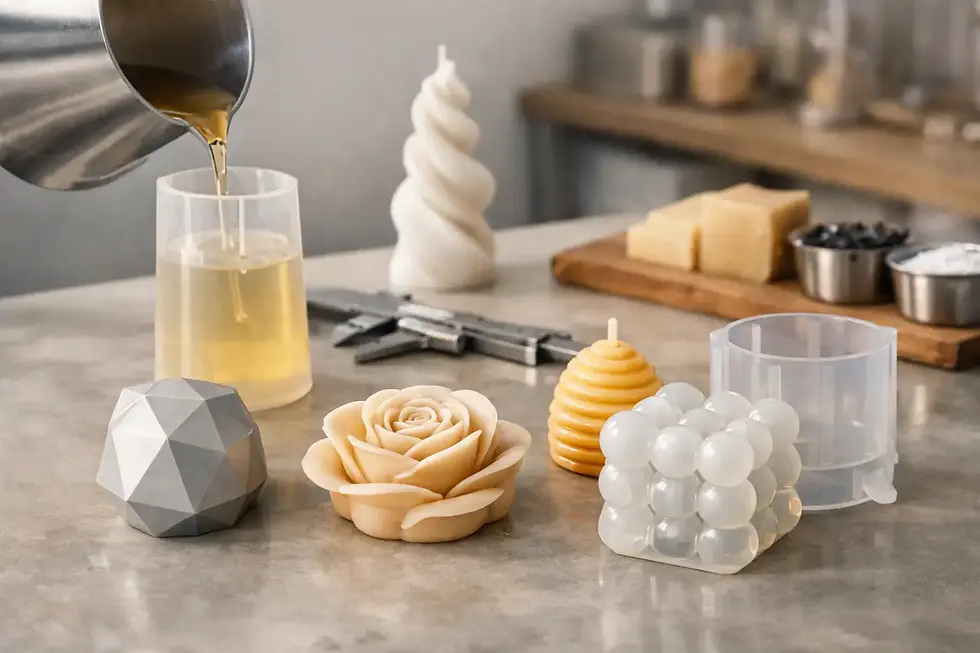
For candle, wax melt, soap and bath product manufacturers, custom tooling helps brands create distinctive products without sacrificing production efficiency. Fine branding details, unusual shapes and seasonal ranges can all be supported more reliably when the mould is designed around the finished item and the behaviour of the poured material.
In resin art and decorative manufacturing, shape complexity and surface finish are often the deciding factors. Here, silicone tooling supports detail capture while allowing release from forms that would be difficult to achieve with more rigid systems.
Industrial and construction applications tend to focus less on appearance alone and more on repeatable function. In these cases, tooling may need to hold tighter dimensional consistency, withstand harsher use or support specialist material systems. The principle remains the same: bespoke tooling performs best when it is engineered around the process.
The trade-offs buyers should consider
Bespoke tooling is not simply a case of custom being better than standard. It is a commercial decision, and the right route depends on what you are trying to achieve.
The upfront investment is higher than buying a generic mould, particularly where design development, prototyping and testing are required. Lead times can also be longer because the tooling is being built around specific requirements rather than pulled from stock. For very low volumes or short-lived product ideas, that may not be justified.
However, the cost comparison changes once repeat production starts. A mould that improves release, shortens handling time and reduces defects can return value quickly. The more critical your tolerances, output consistency and labour efficiency are, the stronger the case becomes for a bespoke solution.
There is also the question of confidentiality. For many brands and manufacturers, product shape is commercially sensitive. Custom tooling developed under NDA-backed processes protects proprietary designs and allows new products to be tested and scaled without exposing them unnecessarily.
What to ask before commissioning custom silicone tooling
The best results usually come from clearer information at the start. A supplier can design more accurately when the production context is properly defined.
It helps to know your target volumes, expected cycle rate and working temperatures. Product dimensions, acceptable tolerances and any critical finish requirements should be identified early. If there are known pain points with existing tooling - sticking, tearing, distortion, overflow, air entrapment or poor fit with current trays and equipment - those details are valuable because they shape the design response.
You should also think about the next stage, not only the current one. A prototype for market testing may need to become a scalable production tool later. Planning for that transition can save time and redesign costs, especially if the product is likely to move from hand processing to a more structured production setup.
Why in-house control matters in custom silicone tooling
When design, prototyping and manufacture are managed in-house, communication tends to be sharper and quality control easier to maintain. There are fewer handovers, fewer opportunities for interpretation errors and more visibility over how the tooling is progressing.
That matters because small changes in tooling manufacture can affect final performance. Material specification, cavity finish, dimensional accuracy and consistency from one mould to the next all have a direct impact on production reliability. Businesses that need dependable repeat output are not only buying a mould. They are buying process control.
For that reason, many buyers prefer a manufacturing partner that can support development from concept through to repeat supply. TCI Mouldings works in that way, combining bespoke design input with in-house production and a practical understanding of how moulds need to function in live manufacturing environments.
Getting the best long-term return
The longest-lasting tooling is not always the most cost-effective if it slows production or complicates handling. Equally, the cheapest option is rarely the best if it introduces defects and replacement cycles. Good value comes from balancing durability, speed, accuracy and ease of use.
That is why successful tooling projects are usually collaborative. The manufacturer brings product knowledge and production priorities. The tooling specialist brings material knowledge, design experience and manufacturing discipline. Between those two perspectives, the final mould is more likely to perform as a working production asset rather than a one-off piece of tooling.
If your mould is central to output quality, labour efficiency or brand consistency, it deserves the same scrutiny as any other production component. Custom silicone tooling is most effective when it is treated that way - as engineered infrastructure for repeatable results, not just a form for shaping material.
The best place to start is with the real problem on your line: where time is being lost, where quality drifts, or where a standard mould is forcing compromise. That is usually where the right tooling solution begins.


Comments