
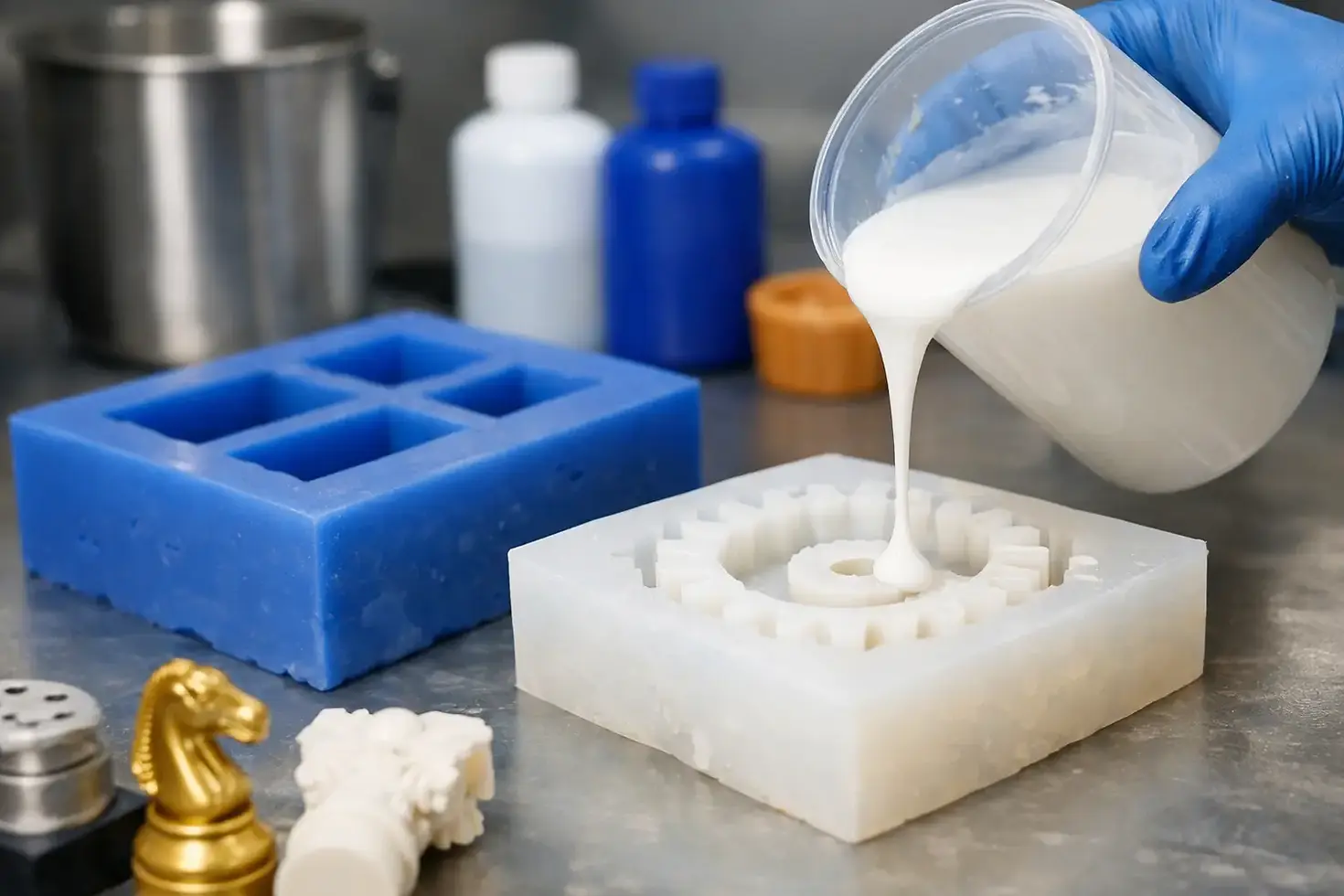
Choosing Commercial Silicone Mould Solutions
- thomas lane
- Jun 16
- 6 min read
When a mould starts slowing production rather than supporting it, the issue is rarely just the material. In most commercial environments, commercial silicone mould solutions need to do far more than form a shape. They need to deliver repeatable output, withstand demanding cycles, protect product quality and fit cleanly into the wider production process.
That is where many off-the-shelf options fall short. A generic mould may work for short runs or basic shapes, but commercial manufacturing places different demands on accuracy, release performance, longevity and throughput. Whether the application is bakery, chocolate, soap, resin, wax or an industrial component, the right mould solution is usually the one engineered around the product and the production line - not the other way round.
What commercial silicone mould solutions need to achieve
At commercial scale, a mould is part of an operating system. It affects filling speed, curing or cooling time, demoulding, labour input, waste rates and final product consistency. If one of those areas is unstable, margins are affected quickly.
Silicone is often selected because it offers a useful combination of flexibility, thermal resistance and release properties. For food production, that can mean smoother release and more reliable shape retention. For candles, soaps and resin products, it can mean cleaner detail and less damage during demoulding. In industrial settings, it may be valued for handling repeated cycles while maintaining dimensional stability.
The key point is that silicone is not a one-size-fits-all answer. Grade selection, wall thickness, cavity layout, part geometry and reinforcement all influence performance. A mould that works perfectly for artisan batches may become inefficient under continuous commercial use.
Where bespoke commercial silicone mould solutions add value
Bespoke moulding becomes commercially valuable when the mould has to match a specific product, output target or workflow. That could involve unusual dimensions, fine surface detail, branding features, multi-cavity layouts or compatibility with existing trays, racks or depositor systems.
For production managers, the value is often practical rather than theoretical. A well-designed custom mould can reduce handling time, improve release consistency and cut the number of rejected parts. In sectors where finish matters, such as confectionery, decorative products or premium bath goods, better mould accuracy also supports a more consistent presentation standard.
There is also a development advantage. If a business is launching a new line, testing formulations or refining dimensions, prototype moulding allows the design to be proved before larger volume manufacture begins. That reduces risk and avoids committing to a tool that looks right on paper but performs poorly in production.
Material choice is only one part of the solution
It is easy to focus on silicone itself, but the success of a mould system depends on design engineering as much as the material. Release angles, undercuts, cavity spacing and support structure all influence how well the mould performs in use.
A food manufacturer may need moulds that cope with repeated temperature changes without distorting or affecting product finish. A soap or wax producer may need a balance between flexibility and rigidity so operators can demould efficiently without deforming the product. A construction or industrial manufacturer may need moulds that retain shape under repeated loading while protecting dimensional accuracy.
This is why mould specification should always start with the application. Product size, required finish, production volume, fill method, cycle time and cleaning requirements all need to be considered together. A technically correct material can still be the wrong commercial solution if it creates bottlenecks elsewhere.
Commercial silicone mould solutions for food production
Food manufacturing places particularly high demands on mould performance. Hygiene, consistency and temperature tolerance are all non-negotiable, and even small variations can affect both product quality and line efficiency.
In bakery and confectionery settings, silicone moulds are often used for shaped products, branded forms and items that require clean release without damage. The benefit is not simply convenience. Better release can mean fewer defects, less waste and faster turnaround between cycles. Where products must meet visual standards, cavity uniformity becomes essential.
For larger producers, layout matters just as much as the individual cavity. Multi-cavity formats can be designed to support throughput targets and fit with existing handling systems. That matters because a mould that creates a beautiful product but slows loading, unloading or transfer is not commercially efficient.
Precision matters in non-food sectors too
Outside food, the same principles apply. Candle makers need moulds that preserve clean lines and detailed shapes while coping with repeated heating and cooling. Soap and bath product brands often require consistent branding and finish across batches, particularly when products are sold at premium price points. Resin and decorative manufacturers may need high-definition detail and stable repeatability for complex forms.
In these sectors, product variation is often costly. If one cavity releases differently from another, or if a mould begins to lose accuracy after repeated use, quality control becomes harder and production planning less predictable. Bespoke moulds help address that by being engineered around the exact form, material behaviour and working method involved.
This is also where confidentiality can matter. For proprietary product designs, shape development is part of the commercial asset. Working with a manufacturer that can support confidential design and in-house control reduces exposure during the development process.
What to look for in a mould manufacturing partner
When specifying commercial silicone mould solutions, buyers should assess more than sample quality. A mould supplier needs to understand the production environment in which the tool will operate.
That includes the ability to interpret drawings or physical samples, advise on manufacturability and identify risks before the mould is made. If a design feature is likely to slow release or reduce lifespan, it is better to address it early than discover the issue once production has started.
In-house capability is also significant. When design, prototyping and manufacture are controlled within one operation, communication is clearer and quality control is easier to maintain. It usually means changes can be managed more efficiently too, which is useful when products are evolving or launch timelines are tight.
For many commercial buyers, supply reliability is just as important as technical quality. Lead times, repeatability between batches and support for scale all matter. A supplier that can produce a prototype but not support rollout may be useful in the short term, but less effective as a long-term manufacturing partner.
Common mistakes when specifying moulds
One of the most common mistakes is choosing on price alone. A cheaper mould may appear cost-effective initially, but if it wears quickly, releases poorly or creates higher reject rates, the real cost is much higher.
Another issue is under-specifying the operating conditions. Heat exposure, cleaning processes, production volumes and handling methods all affect how a mould should be built. Without that information, the mould may be technically acceptable but commercially inefficient.
It is also a mistake to treat the mould as separate from the rest of the process. Good mould design should support filling, setting, demoulding and downstream handling. If it does not, inefficiencies will show up somewhere else in the line.
Why UK-made moulds can be a practical advantage
For many businesses, UK manufacture offers operational benefits beyond geography. Communication is often faster, prototyping can be more straightforward and design revisions are easier to manage. For projects involving sensitive product development, working with a UK-based partner can also support closer control over confidentiality and sign-off.
That matters most when timelines are tight or the mould is central to a launch. Delays caused by unclear specification, inconsistent quality or long correction cycles are expensive. A partner with direct account management and end-to-end oversight can help reduce those risks.
TCI Mouldings works in this space because many customers do not need a catalogue item. They need a mould system engineered for their product, their process and their production targets.
Commercial silicone mould solutions should fit the workflow
The best mould is not always the most complex one. It is the one that performs reliably in the real conditions of use. Sometimes that means a highly detailed bespoke tool. Sometimes it means simplifying the design so operators can work faster and more consistently.
That balance between precision and practicality is where strong mould design makes the biggest difference. If a mould supports repeatability, reduces waste and integrates properly into production, it stops being just a component and starts contributing directly to output.
When businesses approach mould specification with that wider view, they tend to make better decisions. The question is not simply whether silicone can form the product. It is whether the full mould solution is engineered to support commercial production for the long term.


Comments